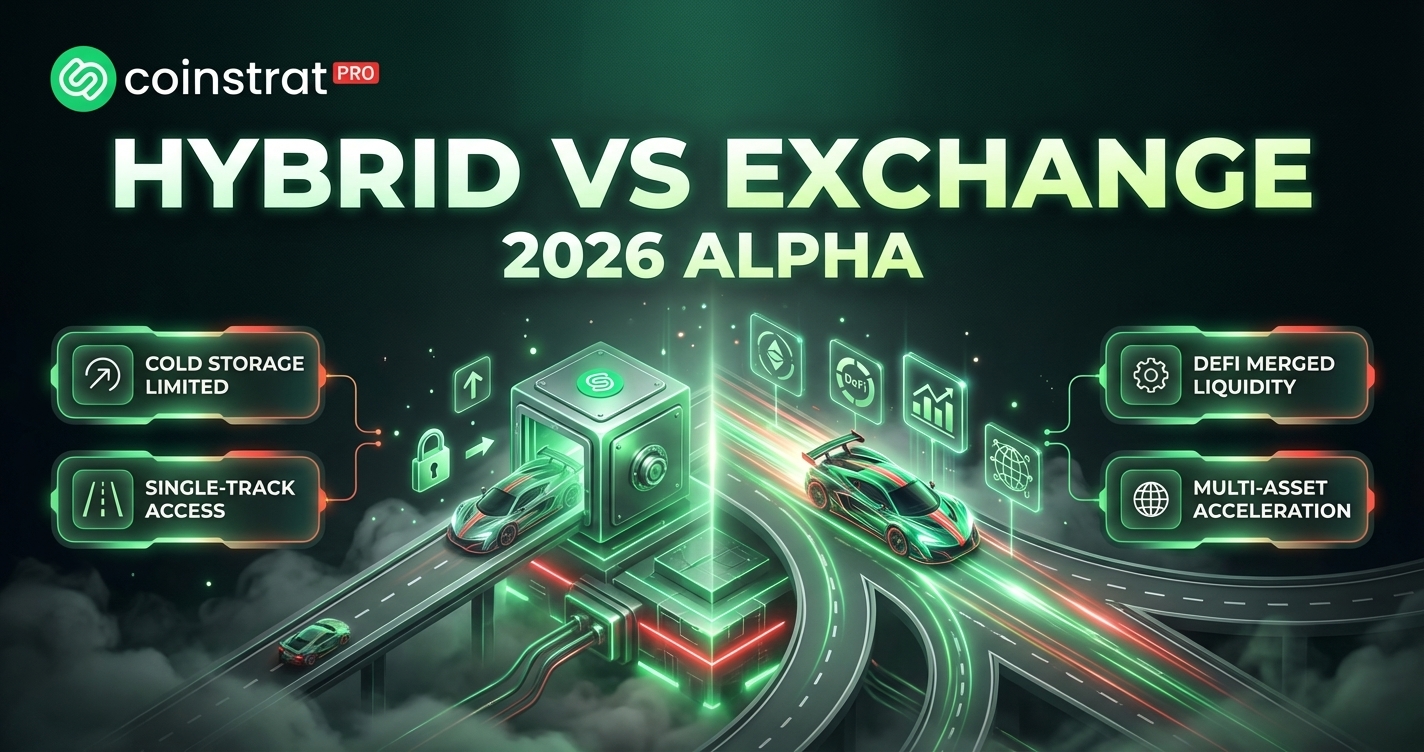
Imagine your capital is a high-performance vehicle. In the current 2026 financial landscape, most investors are keeping that vehicle in a garage (a cold wallet) or driving it solely on a single-track road (a standard crypto exchange). While the garage is safe and the track is familiar, neither allows the vehicle to reach its full potential. The emergence of the “Hybrid Broker” model has changed the mechanics of wealth accumulation by merging the high-yield world of decentralized finance with the institutional precision of multi-asset brokerage.
For the retail investor chasing alpha, the master trader looking to scale, or the affiliate building a network, the choice between a standard exchange and a hybrid broker isn’t just a matter of preference—it’s a matter of capital efficiency. The struggle has always been the “Liquidity Dilemma”: do you lock your tokens away to earn a yield, or do you keep them available to trade market volatility? Historically, you couldn’t do both effectively. Hybrid ecosystems now suggest you no longer have to choose.
Traditional Staking vs Hybrid Crypto Wealth Management Platform Models
Traditional staking is the bedrock of the “old” crypto world. It operates on a simple, albeit restrictive, premise: you prove your commitment to a network by locking your assets. During this lock-up period, which typically spans 30 to 90 days, your assets are essentially “dead” to the market. You cannot sell them during a flash crash, nor can you use them as collateral for a promising trade. If the market moves 20% against you, you sit and watch because the unstaking period—the “unbonding time”—is often longer than the market cycle itself.

A hybrid crypto wealth management platform like Coinstrat Pro fundamentally rewrites this script. Instead of sacrificing liquidity for yield, these platforms treat your deposited assets as living capital. Your assets remain liquid and productive, earning interest while simultaneously serving as collateral or margin for active social trading and copytrade strategies. This “Dual-Utility” model means that while your Bitcoin or Stablecoins are accruing daily interest, they are also powering your ability to mirror the trades of high-performance masters in the FX or Metals markets.
The Comparison: Staking vs. Hybrid Utility
| Feature | Traditional Staking (Exchange) | Hybrid Wealth Platform |
|---|---|---|
| Asset Availability | Locked (30–90 days) | Liquid / Used as Margin |
| Yield Source | Network Inflation/Rewards | Compound Interest + Trading Alpha |
| Risk Management | Limited to “HODLing” | Active Hedging & Stop-Losses |
| Opportunity Cost | High (Cannot trade during lockup) | Zero (Earn while you trade) |
The “Liquidity Trap” is why many sophisticated investors are moving away from fixed-term staking. In a volatile year like 2026, the ability to pivot is more valuable than a fixed 5% APY. By utilizing a hybrid model, you maximize asset utility. If you’re interested in how this looks in practice, exploring the Binance AMA replay – Coinstrat Pro, The World’s First Hybrid Broker provides a deep dive into how institutional execution meets retail accessibility.
Why Multi-Asset Flexibility Generates Better Passive Income
Standard crypto exchanges are, by definition, silos. You are trading crypto against crypto, or crypto against a few fiat pairs. While this is fine for the casual enthusiast, it creates a massive concentration risk for the serious wealth builder. If the entire crypto market enters a correlation-heavy downturn, your “passive income” in the form of token rewards often loses more value in dollar terms than the interest you’ve earned. This is the flaw of the single-token wallet: it is a fair-weather friend.
Multi-asset platforms provide a diversified environment where you can earn interest on stablecoins, Bitcoin, and Ethereum while accessing over 1,200 instruments like FX and Metals to hedge your crypto exposure and stabilize long-term returns. This is the hallmark of a true crypto wealth management platform. Imagine earning 10% APY on your USDT, but using that same USDT balance to short the Nasdaq or buy Gold when the crypto market looks overextended. You aren’t just earning yield; you are building a resilient, multi-weather portfolio.
Diversification as a Yield Enhancer
When you limit yourself to one ecosystem, your “alpha” is capped by that ecosystem’s performance. By contrast, a multi-asset environment allows you to capture gains in the Dow Jones or EUR/USD pairs without ever leaving your crypto-funded account. This is particularly vital for those using multi-asset copy trading. Instead of following a master who only knows how to trade “memecoins,” you can mirror a veteran who navigates the global macro environment, using your crypto as the fuel for those trades.
Furthermore, the ability to hedge is the ultimate “safety net” for passive income. If you hold a significant amount of Ethereum to earn interest, you can use a fraction of your margin to open a hedge position in the futures market during high-impact news events. A standard exchange rarely allows this level of cross-collateralization with professional-grade tools like cTrader, which offers millisecond execution and deep liquidity.
Comparing Compound Interest Crypto Wallet Tech with Exchange Earn Products
We need to talk about the “Math of Money.” Most major exchanges offer “Earn” programs that look attractive on the surface. However, when you look at the fine print, many utilize simple interest. If you earn 5% on 1 BTC, you get 0.05 BTC at the end of the year. Modern compound interest crypto wallet technology operates on a daily (or even sub-daily) accrual basis. This may seem like a small distinction, but over a multi-year horizon, the difference is staggering.

Daily compounding means your interest earns interest starting 24 hours after your first deposit. In a hybrid broker environment, this compounding isn’t just a static number in a database—it’s integrated into your equity. This creates exponential growth where the principal balance swells faster, providing you with more margin for your copytrading activities. For a detailed breakdown of how these rates shift and settle, checking the latest on Interest Rates is essential for any data-driven analyst.
“Simple interest is the arithmetic of the past; daily compounding is the engine of the future. For the trader, every cent of interest that compounds is a cent of additional margin to withstand market fluctuations.”
Daily Accrual vs. Monthly Payouts
The psychological and financial advantage of daily compounding cannot be overstated. When payouts are monthly, as they are on many traditional platforms, you lose 30 days of potential growth on your earnings. Furthermore, institutional-grade platforms provide a level of transparency that standard “Earn” programs often lack. You can see exactly how your yield is generated—whether through dual investment premiums or institutional lending—rather than relying on the “black box” strategies of centralized exchanges.
For those looking for higher-octane returns, products like the Dual Investment Premium offer a way to earn significantly higher APY by committing to buy or sell an asset at a specific price, combining the benefits of a compound interest crypto wallet with the logic of options trading.
The Master Trader and IB Perspective: Scaling and Monetization
If you are a Master Trader, a standard exchange is a cage. You are often limited to a simple profit-share model, and your followers are limited to the few assets the exchange lists. A hybrid broker like Coinstrat Pro provides six distinct fee types—ranging from volume fees to management fees. This allows the professional to monetize their skill set just like a hedge fund manager, but without the million-dollar overhead.
For Introducing Brokers (IBs), the “Unlimited Level” model is the ultimate differentiator. Traditional brokers cap your referrals at 2 or 3 levels. In a hybrid model, the network can grow infinitely deep. This means a financial influencer in 2026 can build a sustainable business where they receive instant commission payouts the moment a trade is executed anywhere in their network. This speed of liquidity—receiving commissions immediately rather than at the end of the month—is what allows for the rapid scaling of Assets Under Management (AUM).
Advanced Risk Control: The Safety of the Hybrid Model
The biggest fear in crypto wealth management is the “total loss” scenario. Standard exchanges offer basic stop-losses, but in a social trading context, these are often insufficient. Hybrid brokers integrate sophisticated risk management tools directly into the copytrade interface. You can set equity risk limits, adjust risk ratios (copying a master at 0.5x risk if you are conservative), and even reverse-copy a trader whose strategy you believe is failing.

By using a copy trading platform with stop loss, you aren’t just blindly following a leader; you are acting as the risk manager of your own mini-hedge fund. This level of control is rarely found on standard exchanges, which prioritize volume over investor protection.
Actionable Steps for 2026 Wealth Building
To move from a passive “HODLer” to an active wealth builder, consider the following roadmap:
- Audit Your Current Yield: Are you earning simple or compound interest? If it’s not compounding daily, you are leaving money on the table.
- Assess Your Liquidity: Are your assets locked? If so, identify what percentage you can move to a hybrid platform to maintain margin for hedging.
- Diversify the Source of Alpha: Don’t just copy traders in one asset class. Balance your portfolio with masters who specialize in FX or Gold to offset crypto volatility.
- Scale Your Network: If you have a following, look for “Unlimited Level” IB structures that provide instant payouts, ensuring your cash flow matches your growth.
The transition from a standard exchange to a hybrid broker is more than a change of platform—it’s a change of philosophy. It’s about moving from a world where your assets sit idle to a world where every Satoshi, Gwei, and cent is working triple-time: earning interest, acting as margin, and building your financial future through professional execution.
FAQ
Can I use my crypto interest earnings to cover trading fees?
In most hybrid broker ecosystems, interest is paid directly into your wallet balance. Since your trading margin and fees are typically drawn from this same balance, your interest earnings naturally offset your operational costs, effectively creating a “fee-free” environment if your yield outweighs your trading frequency.
Is there a minimum balance required to start earning compound interest?
While standard exchanges may require significant minimums for “Earn” programs, hybrid platforms often lower the barrier to entry to encourage liquidity. However, to see meaningful effects from daily compounding, it is generally recommended to maintain a balance that aligns with the minimum lot sizes of the instruments you intend to trade or copy.
How does a hybrid broker protect my principal compared to a DeFi protocol?
Unlike DeFi protocols that are vulnerable to smart contract exploits and “rugged” liquidity pools, a hybrid broker like Coinstrat Pro uses institutional-grade security, insurance coverage, and regulated liquidity providers. You benefit from the yield of the crypto world with the structural safety and recourse of a traditional brokerage.
What happens to my interest if I pause a copytrade allocation?
Your interest accrual is typically independent of your active copytrading status. Because your funds remain in your wallet (rather than being “sent” to the master trader), you continue to earn compound interest on your principal even if you pause or stop mirroring a specific strategy.