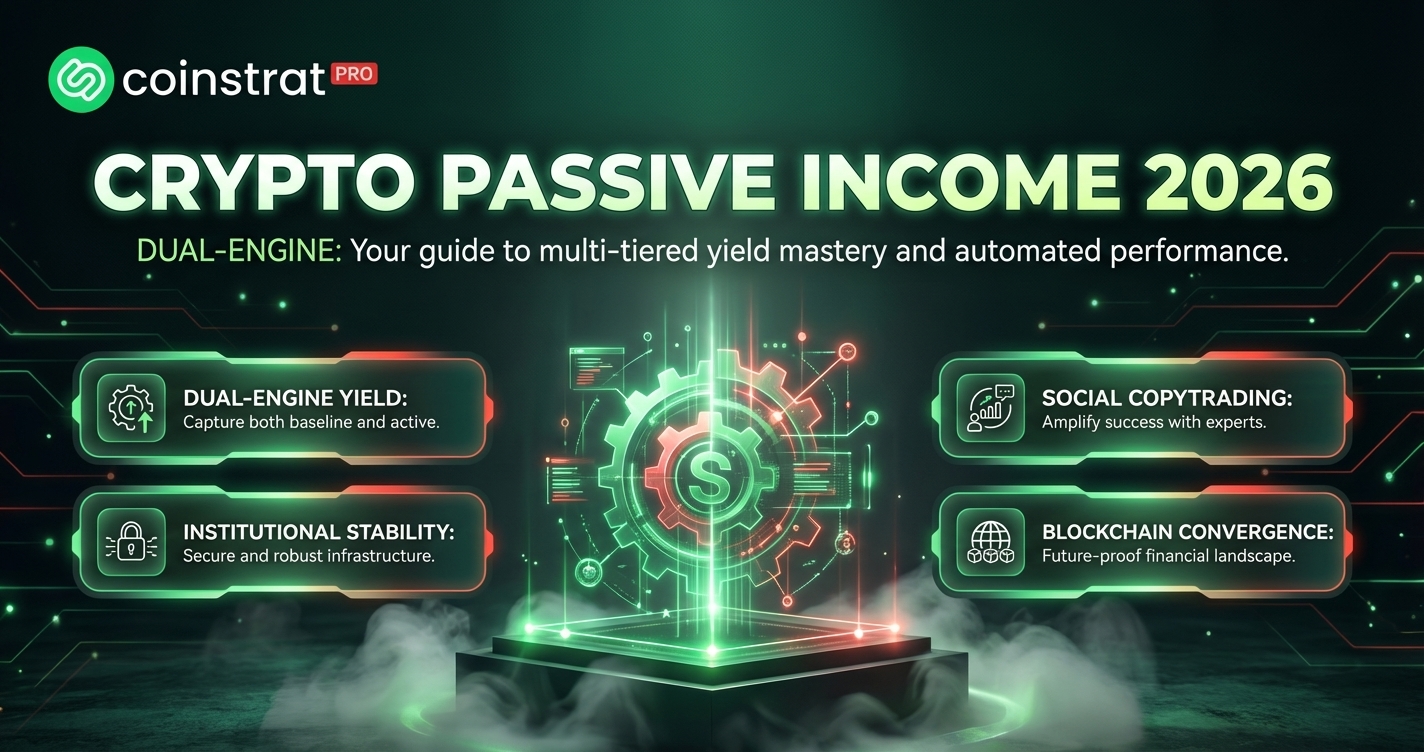
The financial landscape of 2026 has moved past the “wild west” phase of digital assets. We are now in an era defined by institutional stability, sophisticated risk management, and the convergence of traditional finance with blockchain technology. For the modern investor, simply holding a bag of tokens and hoping for a “moon shot” is no longer a viable strategy for long-term wealth. Real sustainability comes from building a multi-layered ecosystem where your capital works for you in two ways: through baseline yield and active performance capture.
To maximize returns in 2026, investors should combine high-yield interest accounts with social copytrading. This ‘Dual-Engine’ approach earns a baseline yield on idle assets while capturing professional market gains (Alpha) by mirroring the trades of high-performing masters on a hybrid brokerage platform. This synergy addresses the primary flaw of traditional passive income: the trade-off between security and growth.
The 2026 Passive Income Blueprint: Interest Plus Alpha
In previous years, investors had to choose. You either locked your assets in a crypto savings account with high yield to earn predictable interest, or you ventured into the volatile world of active trading. Today, the hybrid broker model has shattered this binary choice. By utilizing a single unified account, you can maintain a core balance that earns compound interest while simultaneously using that same equity as collateral for copytrading.

Consider the structure of a sustainable 2026 portfolio. It isn’t just about one asset class; it’s about “yield-stacking.” This involves three distinct layers:
- The Foundation Layer: Stablecoins or blue-chip assets (BTC, ETH) sitting in interest-bearing wallets, providing a “cushion” of 5% to 15% APY.
- The Alpha Layer: A portion of that capital allocated to follow professional “Master Traders” who navigate FX, Indices, and Crypto markets.
- The Referral Layer (for IBs): Scaling wealth by bringing others into the ecosystem and earning instantaneous, multi-level commissions.
Setting Up Your Unified Trading and Savings Account
The first step toward sustainability is consolidation. Managing five different wallets and three exchange accounts creates “leaky” capital through gas fees and transfer delays. A professional-grade setup in 2026 requires a Spot Crypto Wallet that integrates directly with a high-performance trading terminal like cTrader. This allows for near-instant deployment of funds from a savings environment to a live trading environment.
Once your funds are centralized, the goal is to identify your “Core vs. Satellite” ratio. A typical conservative-growth profile might keep 70% of assets in a fixed or flexible interest program and allocate 30% to high-alpha copytrading. This ensures that even if a Master Trader has a “drawdown” month, your total portfolio remains buoyed by the steady Interest Rates accrued on your base capital.
Mastering Passive Income Crypto Trading via Social Copytrade Ecosystems
Passive income in crypto trading is achieved by selecting successful ‘Master Traders’ on a transparent leaderboard. By using automated allocation methods, your account replicates their positions in real-time, allowing you to benefit from professional expertise without needing to monitor charts or execute trades yourself. However, the “set it and forget it” mentality needs to be tempered with intelligent selection.
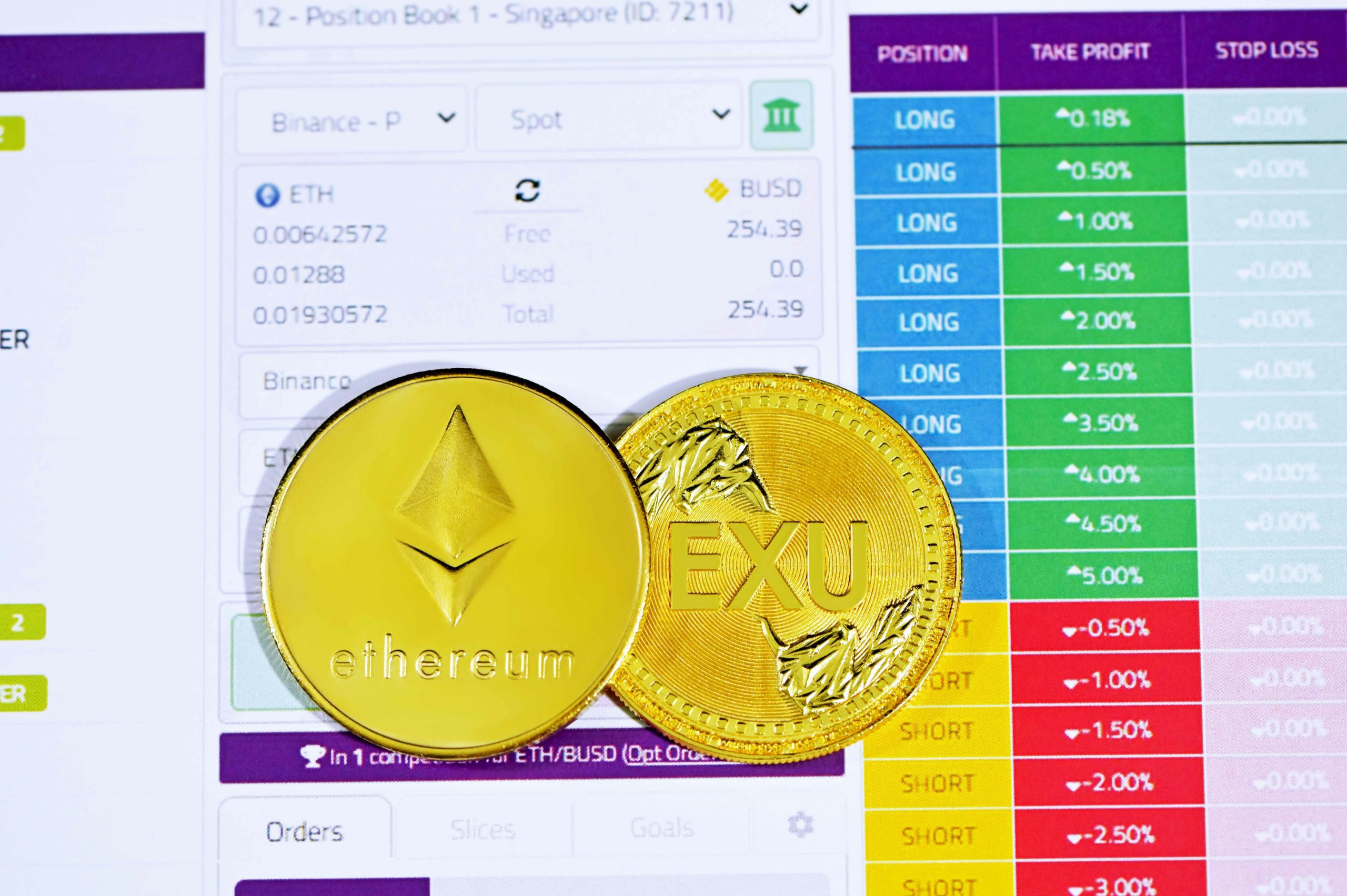
In 2026, the best social trading platforms don’t just show a total profit percentage; they provide a deep dive into risk-adjusted returns. When you are looking for a Master to follow, look beyond the “all-time high” and focus on the Sharpe Ratio and Maximum Drawdown. A trader who makes 200% but risks 80% of the account is not a partner for sustainable wealth; a trader who makes 30% with a 5% drawdown is a gold mine.
The Role of 6 Flexible Allocation Methods in Risk Reduction
One size does not fit all in copytrading. The difference between a blown account and a steady income stream often lies in how you allocate your funds to a Master Trader. Sophisticated platforms now offer six distinct methods to mirror trades:
| Allocation Method | How It Works | Best For… |
|---|---|---|
| Equity Ratio | Scales trade size based on the ratio of your equity vs. the Master’s. | Most balanced approach for all account sizes. |
| Fixed Amount | Every trade is a specific dollar amount (e.g., $100 per trade). | Controlling absolute risk per execution. |
| Lot Ratio | Copies a percentage of the Master’s lot size (e.g., 0.5x or 2x). | Investors with significantly more or less capital than the Master. |
| Fixed Lot | Every trade is a specific lot size (e.g., 0.01 lots) regardless of Master’s size. | Micro-accounts or testing a new strategy. |
| Percentage of Balance | Allocates a specific % of your current balance to a single trade. | Compounding growth as your balance increases. |
| Manual Scaling | Allows the investor to manually override specific trade sizes. | Pro-investors who want “semi-passive” control. |
The ability to use a copy trading platform with stop loss is the final piece of the security puzzle. By setting a hard “Equity Stop Loss,” you can ensure that if a Master Trader’s strategy fails, your copy session disconnects automatically before your principal is compromised.
Maximizing a Crypto Savings Account High Yield through Tactical Reinvestment
The most effective way to use a crypto savings account with high yield is to automatically route interest payouts into a secondary ‘Growth’ sub-account. This sub-account can then be linked to a Master Trader specializing in low-volatility FX or Indices, creating a diversified income stream independent of crypto price action. This is the “House Money” strategy: you only risk the interest you’ve earned, never the initial seed capital.
In 2026, the global economy is more interconnected than ever. While Bitcoin might be stagnant for months, the Japanese Yen or Gold might be experiencing massive volatility. A hybrid broker allows you to earn interest on crypto assets in your wallet while your “interest-only sub-account” trades the volatility of the S&P 500 or EUR/USD. This creates a hedge: your wealth grows in crypto terms via interest, and in fiat terms via multi-asset trading.
Automating the Interest-to-Equity Pipeline
Modern fintech has made this “loop” easier to manage. Advanced users often utilize “Dual Investment” products to capture premium yields during market consolidation. To understand how these advanced structures work, one should look into the Dual Investment Premium models that have become popular in 2026. These allow you to sell high or buy low while earning a guaranteed interest rate, regardless of whether the target price is hit.
Granular Risk Controls: Equity Stop-Loss and Risk Ratios
Sustainability is not just about how much you make; it’s about how much you keep. Beyond the Master Trader’s own Stop Loss, you must implement your own. Professional passive income crypto trading requires setting “Risk Ratios.” For example, if your Master Trader uses a 1:1 ratio, but you are more risk-averse, you can set your copy ratio to 0.5x. You will earn half the profit, but you will only experience half the drawdown.
“The amateur focuses on what they can earn; the professional focuses on what they can lose. In the world of copytrading, your ‘Equity Stop Loss’ is your most important employee.”
Furthermore, the debate regarding mobile-only social trading has been settled in 2026. While mobile interfaces are excellent for monitoring, true professional alpha is managed through robust terminals like cTrader, which offer the millisecond execution speeds required to prevent “slippage” between the Master’s entry and your own.
Scaling Beyond Individual Investment: The Multi-Level IB Advantage
For those looking to build a truly “limitless” passive income stream, the role of an Introducing Broker (IB) has evolved. In the past, IBs were localized referrers earning small kickbacks. In 2026, the “Unlimited Level” IB program allows financial influencers and wealth managers to build entire networks.
When you refer a “Master Trader” to a platform, you aren’t just earning from their trades. You are earning a percentage of the volume generated by every single person who follows them. This creates a geometric growth pattern. If you bring one Master Trader who attracts 500 followers, your commission stream becomes a 24/7 revenue engine. With instant payouts, this liquidity can be immediately rolled back into your own crypto savings account high yield plans, further accelerating the compounding effect.
Actionable Steps for 2026
- Audit Your Yield: Are your assets sitting idle on an exchange? Move them to a hybrid broker environment where they can earn a baseline interest rate.
- Diversify Your Masters: Don’t follow just one trader. Select three masters with non-correlated strategies (e.g., one Gold scalper, one Crypto trend-follower, and one FX swing trader).
- Implement the “Interest-Only” Rule: Start by allocating only 50% of your monthly interest payouts to copytrading. This ensures your principal remains untouched while you explore higher-alpha opportunities.
- Monitor via cTrader: Use institutional-grade tools to check the “Slippage” and “Execution Time” of your copies. If you are consistently getting worse entries than your Master, switch to a provider with deeper liquidity.
Building a sustainable crypto passive income stream is no longer about finding the next “100x” coin. It is about building a professional financial machine that uses high-yield savings as the fuel and expert-led trading as the engine. By 2026, the tools are here—the only variable left is your strategy.
FAQ
How do performance fees impact my net passive income?
Performance fees are typically a percentage of the net profits generated by the Master Trader on your behalf. These are only charged when the trader makes you money (often following a “High Water Mark” rule). While this reduces your gross profit, it ensures the Master’s interests are aligned with yours, as they only get paid when you succeed.
What is the difference between ‘Copy Ratio’ and ‘Fixed Amount’ in copytrading?
‘Copy Ratio’ (or Equity Ratio) scales your trade size proportionally to the Master’s account balance, which is safer for maintaining similar risk levels. ‘Fixed Amount’ executes every trade with the exact same dollar value regardless of the Master’s strategy, which gives you absolute control over spend per trade but may deviate from the Master’s intended risk management.
Are my assets insured while they are being used for copytrading?
In a hybrid broker model, your assets are typically held in secure spot wallets with institutional-grade protection and insurance. While the ‘trading risk’ (losses from market movement) is not insured, the ‘custodial risk’ (theft or hacking) is often covered by the platform’s security framework and third-party insurance providers.
Can I copy multiple master traders with the same pool of assets?
Yes, many advanced platforms allow you to subdivide your capital across multiple Master Traders. This is a key diversification strategy, allowing you to hedge your risk by following different asset classes (e.g., FX and Crypto) simultaneously using the same base account equity.