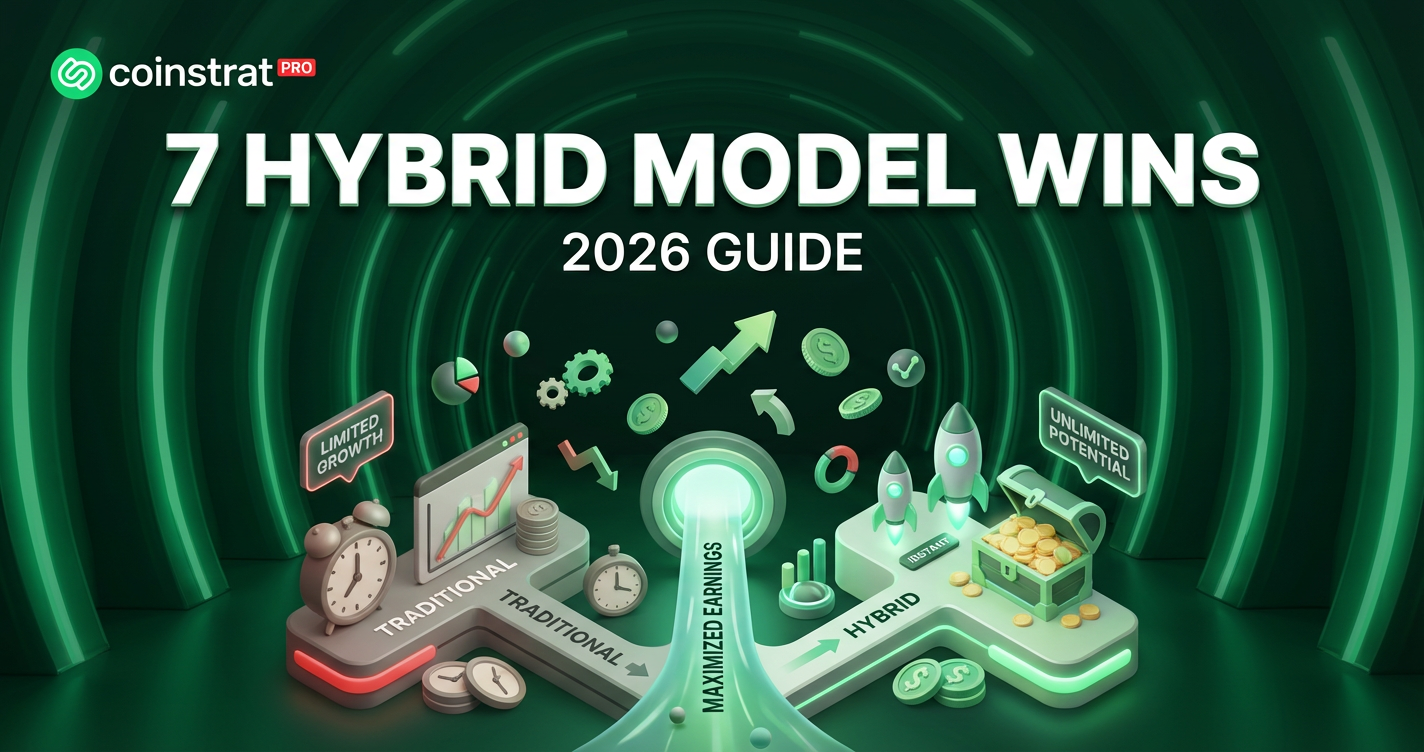
The traditional Introducing Broker (IB) model is undergoing a silent but terminal decline. For a decade, the formula was simple: refer a client, earn a fixed rebate, and wait 30 days for a check. But in a 2026 financial landscape dominated by high-frequency crypto trading, 24/7 global markets, and sophisticated social copytrade ecosystems, that “refer-and-wait” approach is costing partners a fortune in unrealized gains. If you are still operating within a capped, rigid IB framework, you aren’t just leaving money on the table—you are essentially capping your own growth potential before you even start.
The emergence of the hybrid brokerage model has changed the math. By merging institutional-grade multi-asset execution with decentralized-style flexibility, hybrid brokers have eliminated the “glass ceiling” that has long plagued top-tier affiliates. Whether you are focused on recruiting sub-IBs for long-term growth or trying to optimize your personal spread markups, the traditional ways of doing business are increasingly looking like relics of a slower, less efficient era.
7 Reasons Why Traditional IB Models Are Costing You Significant Revenue
Traditional Introducing Broker models often cap referral levels at 2-3 tiers and delay payouts by 30 days. This creates a revenue ceiling and cash flow bottlenecks that prevent aggressive reinvestment into marketing and acquisition. In contrast, modern hybrid models offer unlimited depth and instant payouts, allowing partners to scale their AUM without structural limitations.

1. The Hidden Trap of Capped Referral Tiers
In a standard brokerage, your earning potential is strictly linear. You refer “Trader A,” and you get a commission. If “Trader A” becomes a powerhouse and starts their own sub-IB network, the original broker often cuts you off after the second or third level. This is a massive strategic error. It discourages IBs from training their recruits to become leaders. A hybrid model with an “Unlimited Level” structure ensures that your efforts in 2026 continue to pay dividends in 2030, regardless of how deep the referral tree grows.

2. Payment Latency: The Velocity of Money Problem
Wait times are the enemy of scale. Most traditional brokers operate on a monthly or bi-weekly payout schedule. For an affiliate spending $5,000 a week on digital ads or lead generation, waiting 30 days to see the “fruits” of that labor creates a massive cash flow gap. Hybrid brokers utilize “Instant Payout” technology—the moment a trade is closed by a client, the commission is credited to the IB’s wallet. This allows for immediate reinvestment into growth, effectively increasing the “velocity” of your capital.

3. The Fragmentation of Multi-Asset Tracking
Traditional brokers often struggle to track commissions across disparate asset classes. You might earn well on Forex, but your fees for Crypto or ETFs are either non-existent or tracked in a separate, clunky system. Hybrid models harmonize this. Whether your client is trading Gold, scalping the S&P 500, or holding a long-term position in Bitcoin, the commission is unified in one dashboard. This transparency is vital when scaling trading commission as IB because it allows you to see which assets are actually driving your bottom line.
| Feature | Traditional IB Program | Hybrid Brokerage (Coinstrat Pro Style) |
|---|---|---|
| Referral Depth | Capped (usually 1-3 levels) | Unlimited Multi-Level Tiers |
| Payout Speed | Monthly / Bi-weekly | Instant / Real-time |
| Asset Diversity | Mostly FX & Metals | 1,200+ Assets (FX, Crypto, Stocks, ETFs) |
| Commission Types | Fixed Rebate Only | 6+ Types (Performance, Volume, Management) |
| Customization | Standardized/Rigid | Individually customized markups |
4. Lack of Monetization for Master Traders
Many IBs are also highly skilled traders. In a traditional setup, these “Master Traders” only earn from their own trades or a small fixed rebate. Hybrid models allow these individuals to monetize their skill sets through six distinct fee types, including performance fees, joining fees, and subscription models. This transforms the IB role from a mere “referrer” into a professional “Wealth Manager.”
5. Rigid Administrative Controls
In the old world, if you wanted to offer a specific incentive or adjust a markup for a high-volume client, you had to jump through hoops with a dedicated “Account Manager” who would take three days to reply. Hybrid platforms provide IBs with a toolkit to customize their own business rules instantly. This includes generating promo codes, setting individual markup levels, and adjusting risk parameters for copytraders.
6. The “Siloed” Liquidity Issue
When you refer a client to a traditional broker, they are often locked into one liquidity pool. If that pool dries up during a news event, slippage occurs, the client loses money, and they eventually churn. Hybrid brokers tap into Tier-1 global liquidity data centers, ensuring that even high-volume scalpers (whom IBs love because they generate the most commission) stay happy with millisecond execution speeds under 100ms.
7. Zero Interest on Idle Funds
Traditional brokers treat your commission wallet like a checking account that pays 0% interest. Hybrid models often bridge the gap into the DeFi or “savings” world, offering compound interest on idle balances (BTC, ETH, Stablecoins). Why should your earned commission sit stagnant when it could be earning a 12-20% APY while it waits for you to withdraw it?
Mastering the Art of Recruiting Sub-IBs for Long-Term Growth
To recruit sub-IBs for long-term growth, focus on providing them with superior infrastructure, such as raw spread access and customizable markups. By leveraging a system that supports unlimited levels, your earning potential grows exponentially as your network expands into new markets without manual intervention. Success in recruiting isn’t about finding “anyone”; it’s about finding “multipliers.”

Identifying High-Potential Partners in Your Network
The most lucrative sub-IBs are often already active in the trading community but are frustrated by the limitations of their current platforms. Look for:
- Trading Educators: Those with courses or signal groups who need a reliable home for their students.
- Prop Firm Enthusiasts: Individuals who understand the hybrid brokerage benefits for prop traders—specifically the ability to trade with high leverage while maintaining institutional execution.
- Social Media Influencers: Those who can explain the complexities of 1,200+ instruments to a broad audience.
By offering these partners a “Top IB” status with a 3-level or unlimited payout structure, you align your interests with theirs.
Setting Up Competitive Markup Structures for Success
The “Race to the Bottom” on spreads is a myth. Sophisticated traders don’t want the cheapest spreads; they want the fairest execution. As a primary IB, you can use hybrid tools to set a markup on raw prices. The trick to long-term growth is finding the “Goldilocks Zone”—a markup that is high enough to generate meaningful revenue for your sub-IBs, but tight enough that the end-user (the trader) still perceives a high-value, low-cost environment. Transparency is key here; if a sub-IB understands that the markup pays for the high-performance infrastructure and 24/7 support they receive, they are far more likely to remain loyal.
Using Transparency to Build Partner Loyalty
The “churn and burn” model of IB recruitment is dead. To build a multi-year income stream, you must use the reporting tools provided by your hybrid coordinator. For example, sharing visibility on trade execution speeds and slippage statistics builds trust. When a sub-IB sees that their referred clients are actually profitable because of the deep liquidity provided, they won’t leave for a “slightly higher rebate” at a bucket-shop broker. They stay because their business is sustainable.
“The best recruiting tool isn’t a high commission—it’s a high-performance environment where the sub-IB’s clients don’t lose money to bad execution.”
Scaling Trading Commission as IB Through Hybrid Liquidity
Scaling as an IB requires a broker that provides deep liquidity and diverse assets. A hybrid broker allows you to earn from FX, Crypto, and ETFs simultaneously, ensuring that regardless of market volatility, your commission stream remains diversified and robust across 1,200+ instruments. You are no longer tethered to the volatility of a single market like Forex or Bitcoin; you earn across the entire financial spectrum.
The Power of 1,200+ Financial Instruments
Market cycles are real. There are months when Forex is “choppy” and years when Crypto is in a “winter.” A traditional IB’s income drops significantly during these periods. However, when you offer access to indices, energies, and stocks, your revenue stream is hedged. If the Euro/Dollar is stagnant, perhaps the S&P 500 is hitting all-time highs, or Oil is seeing massive volatility. A hybrid broker ensures your “client shop” is always open and stocked with high-demand goods. Exploring the future of financial trading with hybrid solutions reveals how this multi-asset approach is becoming the gold standard for global wealth management.
Leveraging Zero-Pip Spreads to Attract High-Volume Scalpers
High-volume scalpers are an IB’s best friend. These traders open and close hundreds of positions a day, often with large lot sizes. To attract them, you must offer “Raw” or “Zero-Pip” spreads. Traditional brokers often struggle to maintain these during high volatility, but hybrid models utilize cTrader integration and Prime Liquidity to keep spreads razor-thin. When you market these conditions, you are essentially scaling trading commission as IB through volume rather than just head-count.
The Social Copytrade Factor
One of the most effective ways to scale is through social copytrading. Instead of hoping your referred clients learn how to trade (which can take years), you can direct them to a global leaderboard of Master Traders. By connecting a retail investor to a professional alpha-generator, you accomplish two things:
- The investor is more likely to be profitable, keeping them active (and generating commissions) longer.
- The Master Trader generates massive volume, which flows directly into your IB earnings.
This creates a “flywheel effect” where the community’s success feeds your commissions, and your commissions allow you to further support the community. For those interested in how these networks form, watching a Binance AMA replay can provide deep insights into how hybrid models have integrated these social dynamics at a global scale.
Actionable Steps for Modern IBs:
- Audit Your Current Broker: If you aren’t getting instant payouts or can’t see past 3 tiers of referrals, you are being held back.
- Pivot to Multi-Asset: Stop branding yourself as just a “Crypto IB” or “Forex IB.” You are a “Global Market IB.”
- Leverage Personal Promo Codes: Use the hybrid dashboard to create unique incentives for your sub-IBs to help them launch their own marketing campaigns.
- Focus on Retention: Move clients toward Copytrade Master Traders to ensure they don’t blow their accounts in the first week. Long-term volume is worth infinitely more than a one-time joining fee.
The transition from traditional brokerage models to hybrid ones isn’t just a trend—it’s an evolution. The partners who embrace this change now will be the ones owning the largest networks of 2026. Those who cling to the old, capped methods will find themselves working harder for a smaller piece of a shrinking pie.
FAQ
Does the multi-tier structure reduce the commission of the primary IB?
No. In a properly structured hybrid model like Coinstrat Pro, the commissions for sub-IBs are either calculated as a percentage of the total pool or added as a specific markup. The primary IB’s base rate remains protected, and they typically earn an additional percentage (e.g., 10-20%) from the activity of their downline without it being deducted from their own direct earnings.
What are the specific requirements to unlock the ‘Unlimited Level’ status?
Requirements vary depending on the chosen program. While basic programs are open to all, premium “Top IB” statuses often require a referral from an existing high-level partner or a demonstrated track record of trading volume (e.g., reaching specific 30-day volume tiers). Once unlocked, the ‘Unlimited’ status applies to the depth of the network you can earn from.
Can I offer customized markups for specific high-volume sub-IBs?
Yes. The hybrid model is designed for flexibility. Primary IBs can usually access a partner dashboard where they can tailor markups, commission structures, and even create unique promo codes to help their highest-performing sub-IBs remain competitive and motivated.
Are there any geographical restrictions on recruiting sub-IBs?
Hybrid brokers generally operate on a global scale, supporting multiple currencies (including SWIFT, SEPA, and Crypto). While you should always check local regulations in your specific jurisdiction, the platform infrastructure itself is built to handle sub-IBs and traders from across the globe seamlessly under one unified dashboard.