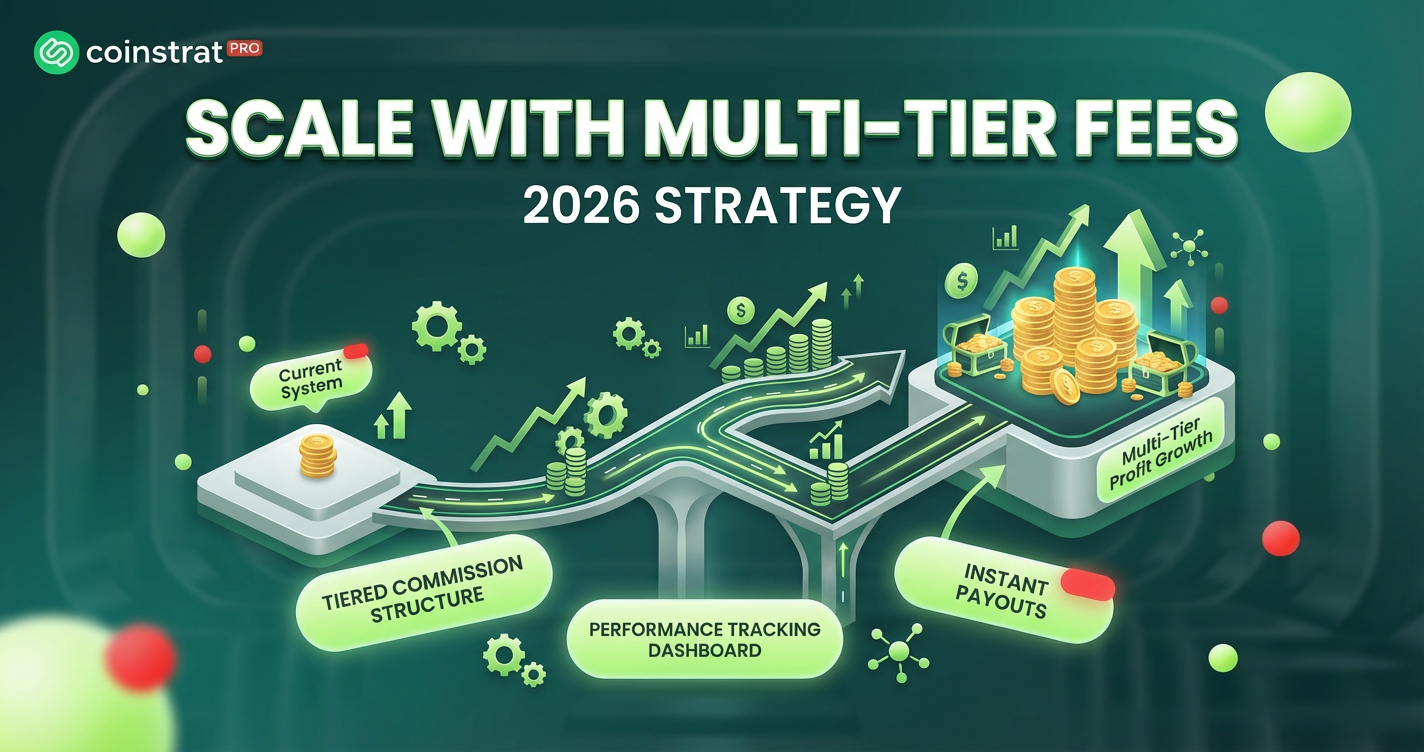
The traditional brokerage model is reaching a breaking point. For years, the industry followed a rigid, binary path: you were either a retail trader battling the charts alone or a professional manager locked behind the gates of institutional high-finance. This disconnect left a massive void in the middle—a “missing middle” where talented traders couldn’t scale and hungry investors couldn’t find reliable alpha.
In 2026, the arrival of hybrid brokerage infrastructure has finally bridged this gap. The most significant evolution isn’t just in the execution speeds or the number of assets; it is in the monetization logic. A sophisticated multi-tier fee structure for master traders is no longer just a “nice-to-have” feature; it is the fundamental engine that allows a trading hobby to transform into a scalable global business. By diversifying how a master trader is compensated, platforms like Coinstrat Pro are effectively creating a sovereign economy for expertise.
Master Trader Monetization: Coinstrat Pro vs. The Competition
A multi-tier fee structure for master traders at Coinstrat Pro offers six distinct revenue streams: Volume, Profit, Joining, Subscription, Management, and Performance fees. Unlike traditional brokers that only offer a flat profit share, this hybrid model allows masters to stabilize their income regardless of market volatility. This shift moves the professional trader away from the “feast or famine” cycle of being paid only when the market trends in their favor, toward a sustainable corporate revenue model.

Beyond Profit Sharing: The 6 Ways to Get Paid
In a standard social trading environment, the Master Trader usually receives a percentage of the profits generated for their followers (Performance Fee). While fair, this model is inherently flawed during periods of market consolidation or “sideways” price action. If the market doesn’t move, the Master doesn’t get paid, despite the immense effort required to manage risk during those times.
The hybrid model solves this by introducing multiple layers of compensation:
- Volume-Based Fees: Earn a commission for every lot traded by your followers. This ensures cash flow even during scalp-heavy, low-net-profit days.
- Subscription & Management Fees: Charge a monthly “retainer” for access to your intellectual property. This mimics the hedge fund model (2/20 structure) at a retail scale.
- Joining Fees: A one-time barrier to entry that ensures your followers are serious, long-term partners rather than “signal hoppers.”
Why ‘Volume Fees’ Provide Stability
Market cycles are unpredictable. High-volatility months might yield massive performance fees, but what happens during the summer doldrums or unexpected macro consolidations? By utilizing volume-based fees, a Master Trader can maintain a baseline of revenue. According to recent analyst reports on multi-asset copy trading strategies, diversification of income is just as important as diversification of the portfolio itself. If you are trading 1,200+ instruments including FX, Metals, and Crypto, your volume remains consistent even when specific sectors go quiet.

| Fee Type | Traditional Broker Model | Coinstrat Pro Hybrid Model | Impact on Scalability |
|---|---|---|---|
| Primary Income | Performance Fee Only (High Risk) | 6 Concurrent Revenue Streams | Stabilizes business cash flow during drawdowns. |
| Entry Logic | Zero barrier to entry | Customizable Joining Fees | Filters out low-quality, high-churn followers. |
| Volume Rebates | Rarely shared with Master | Full Volume-based Fee control | Rewards high-frequency strategies even in flat markets. |
| Management Fees | Non-existent in social retail | Monthly recurring (SaaS model) | Creates predictable, “sticky” recurring revenue. |
The Social Trading Advantage for High-Volume Affiliates
The highest paying social trading affiliate programs leverage institutional-grade tools like cTrader to attract serious investors. By offering transparent leaderboards and six allocation methods, Coinstrat Pro helps IBs attract ‘sticky’ capital that remains on the platform longer than typical retail churn. For an Introducing Broker (IB), the challenge has always been the “churn and burn” of retail traders who lose their deposits quickly. By pivoting to a social trading model, IBs align themselves with Master Traders who have a vested interest in the longevity of the account.
Attracting High-Net-Worth Followers
High-net-worth (HNW) individuals do not “gamble” on signals; they invest in systems. To attract this caliber of capital, an affiliate needs more than just a referral link. They need granular risk controls. Coinstrat’s integration of the cTrader terminal allows followers to set equity risk limits and utilize diverse allocation methods (Equity-to-Equity, Even, etc.). This transparency is the “secret sauce” for the top-tier features investors look for. When an investor feels in control of their risk, they stay longer, deposit more, and generate higher lifetime value for the affiliate.
Customizable Markups: The Power of Personal Pricing
One of the most disruptive features of the Coinstrat Pro ecosystem is the ability for affiliates to set their own markups on raw prices. Most brokers offer a “take it or leave it” commission. In a hybrid model, an IB can decide their own markup on the spread or commission, effectively acting as a “white label” without the massive overhead costs. This allows an affiliate to tailor their pricing to their specific market—lowering costs for high-volume institutional clients or increasing them for premium, high-touch retail communities.

“The pivot from Prop Firm to Broker is the only logical step for 2026. Owning the tech is good, but owning the flow is better.” — Jefferson Lawson, Industry Analyst.
Why Prop Traders are Migrating to Hybrid Brokerage Models
The hybrid brokerage benefits for prop traders include institutional execution and deep liquidity paired with the flexibility of a social ecosystem. Traditional prop firms often have rigid payout rules, whereas Coinstrat Pro’s hybrid model allows for immediate commission access and diverse asset classes. As we see the industry undergo massive consolidation, modern prop firms are shifting toward these hybrid models to avoid the regulatory scrutiny of “demo-only” environments.
Scaling AUM Without Prop Firm Restrictions
Traditional prop trading has a ceiling. You pass a challenge, you get a funded account, and you are capped by the firm’s maximum allocation (often $200k to $400k). If you want to manage $5 million, you’re usually out of luck. However, by acting as a Master Trader on a hybrid broker platform, your Assets Under Management (AUM) are virtually unlimited. Every follower you attract adds to your “pool,” and your 20% performance fee on $10 million of follower equity far outweighs the profit share on a capped $200k prop account.
Managing 1,200+ Instruments from One Account
Complexity is the enemy of execution. In the old world, a trader might need a crypto wallet for Bitcoin, a MT4 account for Forex, and a separate brokerage for Stocks. Coinstrat Pro unifies this through its Spot Crypto Wallet and hybrid infrastructure. You can hedge your FX trades with physical gold or diversify into ETFs and Indices without ever switching platforms. This “all-in-one” solution ensures that when a Master Trader spots an opportunity in any market—be it a crypto breakout or an interest rate decision affecting the EUR/USD—they can capitalize on it instantly for their entire follower base.
The Final Piece: Immediate Payouts
Perhaps the biggest pain point in the trading industry is the “payout wait.” Traditional brokers and prop firms often have 14 to 30-day waiting periods for commissions. The Coinstrat Pro Multi-Level IB program eliminates this by offering instant payouts. The moment a trade is executed, the commission is calculated and credited. This isn’t just a convenience; it is a business tool that allows affiliates and traders to reinvest their capital faster, accelerating the compounding effect of their growth.
Actionable Strategy: How to Build Your Hybrid Business
If you are serious about scaling in 2026, you cannot rely on a single source of income. Here is the blueprint for transitioning to a hybrid model:
- Audit Your Trading Style: Determine if your strategy is high-frequency (volume-focused) or swing-based (performance-focused). Set your fee structure to prioritize the stronger of the two.
- Onboard a Strategy: Instead of just “trading,” treat your account as a strategy product. Use Coinstrat Pro’s hybrid solutions to list yourself on the global leaderboard.
- Leverage the IB Program: Even if you are a trader, you should be your own first affiliate. Use the unlimited multi-level structure to build a network of other traders, earning a slice of the global volume while you focus on the charts.
- Risk Control as Marketing: Use the 6 allocation methods as a selling point. Show your potential followers exactly how they can limit their downside—this builds the trust necessary for high-ticket AUM management.
The future of trading isn’t just about being a “good trader”; it’s about being a savvy operator of a financial ecosystem. The tools are here—it’s time to use them.
FAQ
Can I switch between volume-based and profit-share fees?
Yes, at Coinstrat Pro, Master Traders have the flexibility to define their fee structures. While most traders choose a combination of both to balance stability and growth, you can adjust your monetization strategy to fit your trading style or the preferences of your follower base.
Does Coinstrat Pro offer swap-free accounts for my followers?
Yes. The platform provides tiered account types, including swap-free options. This is particularly beneficial for strategies that hold positions overnight and for followers who require Sharia-compliant accounts or simply want to avoid the costs of carry in long-term trades.
How do joining fees impact follower retention?
Joining fees act as a psychological and financial filter. While high joining fees might limit high-volume “signal hoppers,” they tend to attract more committed, long-term investors. This leads to higher retention rates and a more stable AUM, as followers who pay an upfront fee are less likely to disconnect during periods of expected market drawdown.
Can I set different fee structures for different sub-groups?
The hybrid brokerage model is designed for maximum customization. Through advanced IB and Master Trader toolkits, you can tailor incentives, markups, and fee structures for different segments of your network, allowing you to offer “VIP” tiers for larger investors or specialized rates for your affiliate partners.