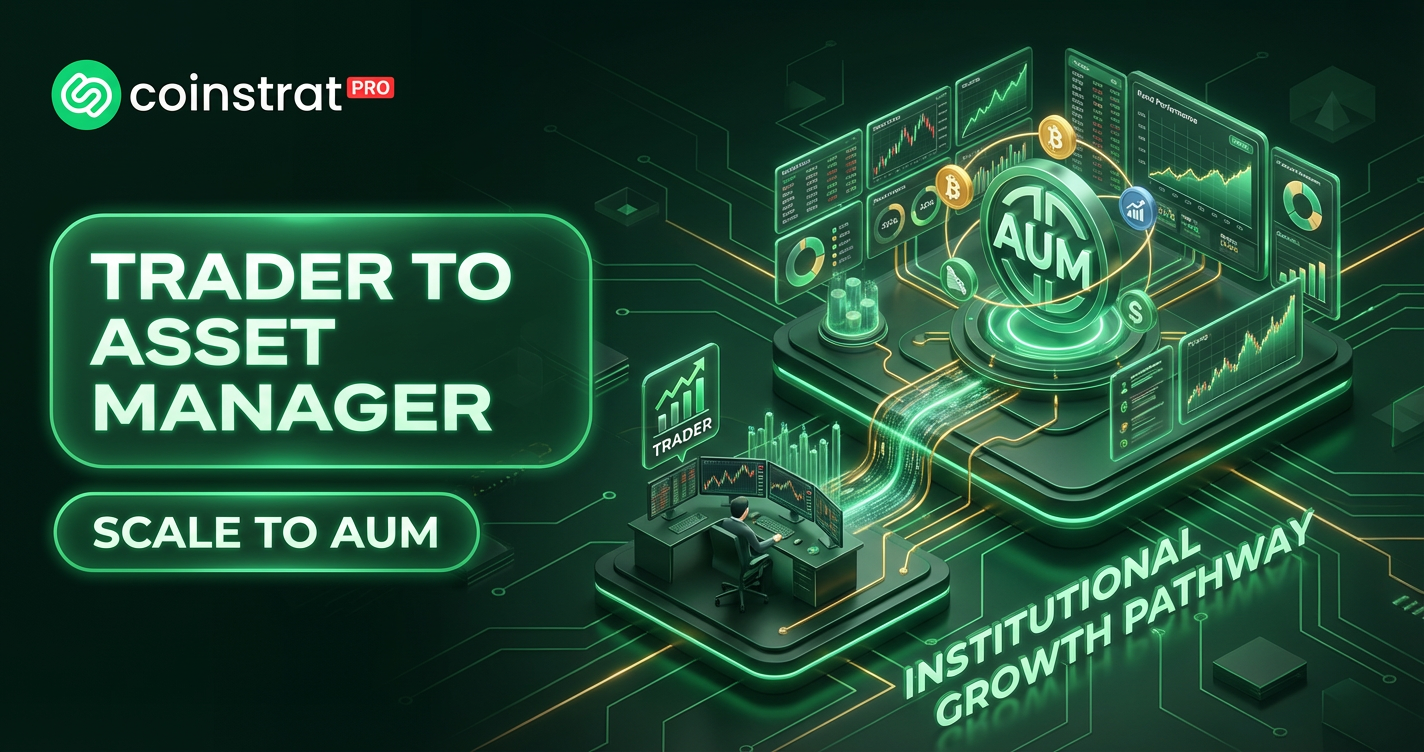
Treating Your Strategy as a Financial Product
To transition from a trader to a fund manager, you must stop focusing on single-trade wins and start optimizing for AUM growth. This involves formalizing your risk management, selecting a multi-asset environment that supports institutional execution, and utilizing comprehensive monetization models like Coinstrat Pro’s six distinct fee types to ensure sustainable business revenue. Most skilled traders remain “retail” because they view their P&L as their only income. An investment business, however, treats the strategy as the product and the investors as clients who pay for the privilege of stability and risk-adjusted growth.
I’ve seen dozens of brilliant technical traders hit a ceiling at $50,000 in personal capital. They have the “edge,” but they lack the infrastructure. When you move into the realm of social trading copytrade monetization 2026, you aren’t just trading; you are marketing a track record. Your “Alpha”—the ability to beat the market—becomes your primary marketing asset. But in the institutional world, Alpha without controlled drawdown is considered “junk beta.” To build a real business, you must define your strategy’s parameters: What is your maximum expected drawdown? What is your Sharpe Ratio? These are the metrics professional capital looks for on a leaderboard.
Moving from a retail psychology to institutional asset management means prioritizing 1% steady gains over 20% “hail mary” weeks. Investors don’t just pay for profit; they pay for the peace of mind that their capital won’t evaporate overnight. By formalizing your strategy within a high-performance environment like Coinstrat cTrader, you provide the transparency and execution speed (millisecond execution) that large-scale investors demand. You are no longer just a trader; you are the CEO of your own digital hedge fund.
Mastering the 6 Building Blocks of Trading Revenue
Expert traders can maximize earnings by moving beyond simple profit sharing. Effective capitalization includes implementing subscription fees for steady cash flow, management fees for AUM maintenance, and volume-based fees to reward high-frequency precision—all supported by Coinstrat Pro’s hybrid infrastructure to capture both Forex and Crypto market participants. Relying solely on a 20% performance fee is a “boom or bust” model that makes it impossible to project monthly business revenue.

The secret to tối ưu hóa 6 loại phí master trader trên cTrader (optimizing the 6 types of master trader fees) lies in balancing your short-term needs with long-term investor retention. In 2026, the competitive landscape for social trading requires a more nuanced approach than the “High Water Mark” performance fee alone. Here is how professional masters structure their revenue:
| Fee Type | Strategic Purpose | When to Use It |
|---|---|---|
| Performance Fee | Rewards the Master for generating actual profit (High Water Mark). | Standard for all strategies to align interests with investors. |
| Management Fee | A percentage of AUM (Assets Under Management) for administrative costs. | Essential for strategies with long-term holding periods or high overhead. |
| Volume Fee | Earned per million units traded by followers. | Best for scalping or high-frequency strategies where execution is the value. |
| Subscription Fee | A recurring monthly fee regardless of performance. | Creates stable cash flow; used by traders with a strong personal brand. |
| Joining Fee | A one-time setup cost for new followers. | Used to filter out “noise” and attract committed, high-net-worth capital. |
| Copying Fee | Fixed fee per trade copied to the investor’s account. | Useful for signal-based services rather than full wealth management. |
If you are a master trader aiming for $1M+ in AUM, you should consider a mix. For instance, a small 1% Management Fee ensures your business stays afloat during “flat” market months, while the Performance Fee provides the massive upside. High-frequency traders can leverage Volume Fees to monetize their activity level. This multi-layered approach turns your trading skill into a diversified revenue stream, reducing the pressure to “over-trade” just to hit a performance target.
Balancing Performance and Retention
While it’s tempting to set a 50% performance fee, you’ll find that “sticky capital” (investors who stay for years) prefers a 15–25% range paired with high-quality execution. The cTrader backend allows you to automate these calculations, ensuring that your payouts are instant and accurate. This level of automation is what separates a professional business from a “side hustle.”
Building Institutional Trust Through Transparency and Connectivity
Success in the fund management business relies on client trust, which is built through transparent execution and robust infrastructure. Utilizing a cTrader-integrated hybrid broker ensures millisecond execution and deep liquidity, allowing your ‘fund’ to scale across 1,200+ instruments including FX, Metals, and Indices without slippage eroding your performance fees. When an investor sees that their entry price matches yours precisely, trust is solidified. When there is a 5-pip “master-follower gap,” the business eventually fails.
In the world of 2026 social trading, “connectivity” means more than just a fast internet connection. It means providing your clients with an ecosystem where they can manage their funds as easily as you manage your trades. Coinstrat Pro’s support for 18+ currency SWIFT/SEPA transfers and instant internal transfers between spot crypto wallets and trading accounts removes the “friction” that often prevents retail investors from scaling up. If it takes three days for an investor to move money into your strategy, you’ve already lost them to a more agile competitor.
Furthermore, professional risk controls are your best marketing tool. By allowing followers to set their own equity limits or reverse copies, you aren’t losing control—you are providing safety features. A master trader who encourages followers to use “Equity Risk Limits” shows that they prioritize client survival over their own volume fees. That ethical stance is what attracts the largest Partners and Introducing Brokers (IBs) to your network, as they can confidently refer their high-end clients to you without fear of catastrophic loss.
“The difference between a trader and an asset manager is the infrastructure. One hunts for pips; the other builds an ecosystem that scales with every new dollar.”
Leveraging Multi-Asset Diversification
Modern investors don’t want just Forex. They want exposure to Gold, Crypto, and major Indices like the S&P 500. By choosing an infrastructure that supports over 1,200 instruments, you can pivot your “fund” to where the volatility is. If the FX markets are sideways, you can scale into Crypto or Energies without forcing your followers to open new accounts. This “hybrid” approach—blending traditional assets with digital ones—is the hallmark of social trading copytrade monetization 2026.
Conclusion: The Blueprint for a Scalable Trading Business
To move from a lone practitioner to a recognized fund manager, you must move beyond the “trader mindset.” The path is clear:
- Standardize Your Edge: Focus on risk-adjusted metrics like the Sharpe Ratio and max drawdown.
- Diversify Your Fees: Move beyond performance fees and implement management or subscription models through cTrader to stabilize your business’s cash flow.
- Provide Institutional Infrastructure: Use a hybrid broker that offers deep liquidity and millisecond execution to ensure your followers get the same results you do.
- Scale via Partners: Work with IBs and affiliates by offering them transparent, multi-level rewards that incentivize them to bring you larger AUM.
The tools exist today to run a global investment firm from a single cTrader terminal. The only thing missing is the shift in perspective from “how much can I make today?” to “how much can I manage tomorrow?”
FAQ
Can I set different management fees for different investor groups?
Yes, advanced platforms like Coinstrat Pro allow master traders to create multiple “strategy” profiles or utilize tiered structures where different groups of investors (such as VIPs versus retail) can be offered different fee arrangements, often managed through specialized promo codes or private links.
How does the cTrader backend assist in professional reporting for investors?
The cTrader backend provides real-time, transparent reporting including detailed equity charts, drawdown analysis, and historical trade data. This allows investors to see exactly how their capital is being managed, which builds the institutional-grade trust necessary for scaling AUM.
Is there a minimum AUM required to start using the 6 fee types?
No, there is typically no minimum AUM required to activate these fee structures. You can begin optimizing your revenue from day one, even with a small pool of followers, allowing your business model to grow organically alongside your performance.
How do instant commission payouts improve my fund’s cash flow?
Unlike traditional brokers that settle monthly, instant payouts allow you to reinvest in your business (marketing, technology, or capital) immediately. This liquidity matches the speed of the modern market and ensures your operations are never stalled by administrative delays.