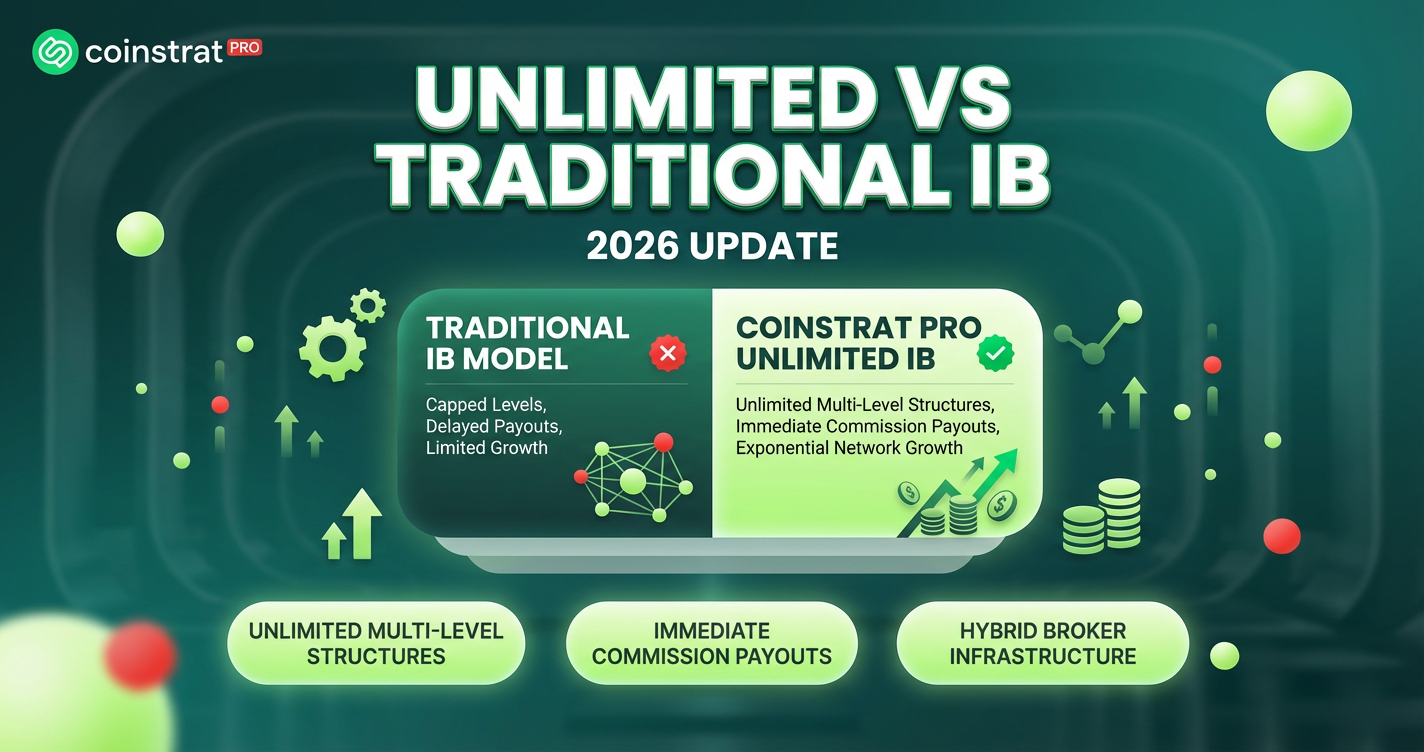
Legacy vs. Modern: Comparing Capped and Unlimited IB Models
Traditional IB models typically cap referrals at 2-5 levels, creating an ‘income ceiling’ for growth-oriented partners. In contrast, modern unlimited-level structures allow for infinite depth, meaning an IB can earn commissions from a referral’s referral, five or fifty levels deep, unlocking true geometric growth potential. This fundamental shift in architecture transforms the Introducing Broker (IB) from a simple lead generator into a genuine network architect, where the value of a sub-IB network grows exponentially rather than linearly.
The “income ceiling” inherent in 3-tier or 5-tier systems is often a result of legacy database limitations or a broker’s desire to keep a larger share of the spread for themselves. When an IB hits that cap, their incentive to mentor their downline vanishes. Why spend time training a sub-IB to become a high-volume producer if that sub-IB’s own network expansion yields zero return for the original partner? This structural flaw leads to “horizontal stagnation,” where partners focus only on direct recruitment (width) rather than building a sustainable, self-replicating ecosystem (depth).
The Hidden Costs of ‘Level Caps’ in Affiliate Marketing
When a brokerage imposes a cap on levels, they are essentially telling their most successful partners that their growth has a shelf life. For a professional partner, this creates a significant opportunity cost. If you build a network of 500 traders, but 400 of those traders fall outside your commissionable tiers because they were referred by your third-tier sub-IBs, you are effectively providing free marketing for the broker. According to industry analysis of affiliate retention, IBs operating under unlimited-level structures tend to stay active 3.5 times longer than those under capped models, primarily because the potential for “passive” geometric growth remains alive indefinitely.
Why Depth Matters More Than Width for Sustainable Wealth
In the world of financial networking, width is fragile; depth is resilient. If an IB has 10 direct clients and 5 stop trading, their income drops by 50%. However, in an unlimited-level structure, an IB can focus on developing a few “Master IBs” who then build their own massive organizations. This creates a diversified revenue stream that isn’t dependent on the IB’s personal daily grind. Geometrically, the math is undeniable: a network that branches out even slightly at every level quickly surpasses any volume a single individual could generate through direct referrals alone.
| Feature | Traditional Capped Model | Unlimited Hybrid Model |
|---|---|---|
| Depth Limit | Usually 2 to 5 levels | No limit (Infinite depth) |
| Revenue Type | Linear / Restricted | Geometric / Exponential |
| Incentive Structure | Direct recruitment focused | Network mentoring & development |
| Scalability | Hard cap on AUM influence | Scales with global network growth |
| Payout Velocity | Weekly or Monthly cycles | Instant (Trade-by-trade) |
A-Book vs B-Book IB Terms: Which Strategy Maximizes Long-Term Revenue?
A-Book IB models earn from volume-based commissions, favoring high-frequency traders, while B-Book models often trade against the client. A hybrid model is superior for IBs as it provides the transparency of A-Book execution with the robust liquidity and multi-asset range of institutional-grade infrastructure, ensuring client longevity and stable IB fees. Choosing between the best b-book vs a-book IB models requires understanding that while B-Book models might offer higher initial rebates, they often lead to shorter client lifespans due to inherent conflicts of interest.
In a pure A-Book (STP/ECN) environment, the broker passes the trade directly to a liquidity provider (LP) like a Tier-1 bank. The broker makes money by adding a small markup to the spread or charging a commission. For the IB, this is the “cleanest” model. You are paid because your clients are trading. If they win, they trade more, and you make more. There is no incentive for the broker to see the trader lose. This alignment of interests is the bedrock of long-term wealth management.
Analyzing the Revenue Potential of Hybrid Execution Platforms
The “Hybrid” model—often utilized by sophisticated entities like Coinstrat Pro—combines the best of both worlds. It uses “A-Book” routing for professional, high-volume traders to ensure market neutrality, while utilizing sophisticated risk management for smaller, retail flow. For the IB, this means their clients get the best possible execution speeds (often sub-100ms) without the “slippage” issues common in pure B-Book shops. When execution is seamless, client turnover (churn) drops. A trader who stays with a broker for three years is worth infinitely more to an IB than a trader who blows their account in three weeks due to poor execution or artificial price spikes.
Why Multi-Asset Brokers Offer More Stable IB Income
A common pitfall for IBs is tethering themselves to a “Forex-only” broker. Markets are cyclical; when FX volatility dies down, crypto might be surging. When crypto is in a bear market, gold (Metals) or the S&P 500 (Indices) might be the primary drivers of volume. A hybrid broker that offers 1,200+ instruments allows an IB’s commission stream to remain stable regardless of which specific asset class is currently in favor. By diversifying the “inventory” your clients can trade, you are effectively recession-proofing your IB business.
Social Trading vs. Manual Trading: Engagement and Retention Comparison
Social trading platforms significantly outperform manual-only brokers in IB retention. By allowing clients to mirror master traders, IBs reduce the ‘churn rate’ associated with beginner losses. Master traders act as the engine for the IB’s volume, keeping the network active and the commissions flowing. A social trading platform for master traders isn’t just a tool for the investor; it is a retention engine for the affiliate partner.
Data from various social trading networks suggest that investors who “copy-trade” stay active for an average of 40% longer than those who attempt to trade manually. Manual trading requires high emotional intelligence and years of technical study—barriers that lead many retail investors to quit after their first few losses. Social trading removes these barriers. An IB can introduce a client to a “Master Trader” with a proven track record, and the client’s engagement shifts from “stressful work” to “portfolio monitoring.”
Master Traders as the ‘Product’ for Your IB Business
In a modern ecosystem, the IB doesn’t just sell “a broker.” They sell access to expertise. By leveraging a leaderboard of high-performing masters, an IB can curate a “fund-like” experience for their referrals. This elevated service model allows the IB to move away from “churn and burn” marketing and toward a wealth-management approach. Furthermore, platforms like Coinstrat Pro offer advanced allocation methods (such as equity-based or lot-for-lot copying), giving the IB tools to help their clients manage risk even more granularly.
“The shift from manual trading to social copy-trading has reduced the average retail trader’s failure rate by approximately 30%, which directly correlates to a 30% increase in long-term IB commission stability.” — Financial Analyst Insight, 2026.
The 6-Fee Monetization Model vs. Simple Profit Sharing
Traditional social trading platforms usually only offer a “Profit Share” for Master Traders. However, advanced hybrid models have introduced more complex monetization layers. For an IB who is also a Master Trader, the ability to earn from multiple streams is a game-changer. These might include:
- Volume Fees: Earned on every lot traded, regardless of profit or loss.
- Management Fees: A percentage of the total Assets Under Management (AUM).
- Performance Fees: A share of the new profits (High-Water Mark).
- Joining Fees: A one-time fee for entering the copy-pool.
- Subscription Fees: Recurring monthly access fees.
This multi-faceted fee structure allows Master Traders to scale their business professionally, attracting more AUM and, by extension, generating more commissions for the IBs who refer them. It creates a “flywheel effect” where success breeds more success.
Choosing Your Partner: Global Connectivity and Multi-Level Support
When choosing an IB partner, analyze their infrastructure: do they support SWIFT/SEPA in 18+ currencies? Do they offer immediate payouts? Brokers that integrate local financial connectivity with unlimited level IB commission structures provide IBs the agility needed to dominate local markets while scaling globally. In 2026, waiting 30 days for a commission payout is no longer acceptable; professional partners demand real-time liquidity for their own earnings.
The technical “plumbing” of a broker is often overlooked until it fails. For an IB, “stable plumbing” means deep Tier-1 liquidity and a robust terminal like cTrader. When a Master Trader executes a large order, that order must be mirrored across hundreds or thousands of follower accounts simultaneously without “slippage.” If the broker’s infrastructure is weak, the followers get worse prices than the Master, leading to complaints and exits. A high-performance infrastructure ensures that the IB’s reputation remains intact.
The Importance of 24/7 Digital Asset Availability for IBs
The integration of Spot Crypto Wallets within a traditional brokerage framework has changed the game for global IBs. In many regions, traditional banking is slow and expensive. By allowing clients to deposit and withdraw via stablecoins or major cryptos, brokers remove the friction that often stops a client from funding an account. For the IB, this means faster “Lead-to-Live” conversion rates. Furthermore, features like “Crypto Interest” allow clients to earn on their idle capital, keeping their funds within the ecosystem even when they aren’t actively trading.
Instant Payouts: The Lifeline of a Professional Affiliate Network
Cash flow is the lifeblood of any business. Modern IB programs have moved away from the “monthly reconciliation” model to instant payouts. The moment a client’s trade is closed, the commission is calculated and credited to the IB’s account. This allows the IB to reinvest in marketing, pay their sub-partners, or simply enjoy the fruits of their labor without delay. This level of transparency and speed is a hallmark of the transition from “Old Guard” brokers to modern “Hybrid” powerhouses like Coinstrat Pro.
Scaling Across 1,200+ Instruments: Why Asset Variety Protects Your Business
Imagine being an IB during a quiet period for the Euro/USD. If your broker only offers FX, your income hits a wall. But if your broker offers Indices (like the NAS100), Metals (Gold/Silver), and Stocks (Apple, Tesla), your clients will always find something that is moving. Multi-asset availability isn’t just a “feature”—it is a risk-mitigation strategy for the IB’s personal income. By providing a one-stop-shop for all financial needs, from high-leverage trading to interest-bearing crypto savings, the broker ensures that the client never needs to look elsewhere, effectively “locking in” the IB’s commission stream for the long term.
Key Takeaways for Professional Partners
- Prioritize Depth: Look for “Unlimited Level” structures to maximize the geometric growth of your sub-IB network.
- Demand Execution: Ensure the broker uses a hybrid A-Book model to provide clients with professional execution and longevity.
- Leverage Social: Use copy-trading as your primary retention tool to lower churn and keep retail clients engaged.
- Focus on Speed: Choose partners that offer instant commission payouts and seamless crypto-to-fiat gateways.
In summary, the era of the “Simple Broker” is over. We have entered the era of the “Wealth Ecosystem.” For IBs and Master Traders, success no longer depends just on finding clients—it depends on finding the right infrastructure that allows those clients to thrive and your network to grow without artificial boundaries.
FAQ
Why do many brokers cap IB levels at 3 or 5 tiers?
Most traditional brokers cap levels due to technical limitations in their legacy back-office systems or to preserve their own profit margins. By capping levels, they prevent “commission dilution” where a large percentage of the spread is paid out to a deep network of partners. This, however, limits the growth potential of high-level IBs who wish to build global organizations.
Does a hybrid model affect the speed of commission payouts?
On the contrary, a modern hybrid model—leveraging high-performance infrastructure like cTrader—is often designed for instant payouts. Because the system tracks trades in real-time and manages risk through automated A-Book/B-Book routing, it can calculate and credit IB commissions the moment a trade is closed, unlike older brokers that require manual end-of-month audits.
Can I offer my clients both A-Book transparency and B-Book execution speeds?
Yes, this is exactly what a “Hybrid” model provides. It uses A-Book routing for large or professional orders to ensure real market access and no conflict of interest, while utilizing institutional-grade liquidity pools to offer the lightning-fast execution speeds (often under 100ms) that were historically associated only with internal B-Book market makers.
How does multi-asset availability (Crypto, FX, Stocks) impact IB commissions?
Multi-asset availability stabilizes IB income by diversifying the “trading triggers” for your clients. When one market is stagnant, another is usually volatile. By providing access to 1,200+ instruments including Crypto, FX, and Stocks, the broker ensures constant trading activity, meaning the IB earns commissions consistently across different economic cycles and market conditions.