You move fast. You read order flow, you scale in, you cut losers without flinching. So here is a number to run through that same cold filter before you tap “buy” on your next challenge: out of every 100 traders who purchase one, about 7 ever get paid a single dollar.
That is not a doom stat pulled from a forum. It comes from an analysis of 300,000 prop accounts across ten firms, and it is the single most useful base rate you can carry into a purchase decision. You already size positions by probability. Size this one the same way.
Run the funnel before you run the strategy
Most traders study the strategy and skip the base rate. Flip that. Picture 100 buyers stepping into a challenge today. Around 14 of them pass and get a funded account. Of those 14, fewer than half, roughly 45.0%, ever reach a payout. Multiply it out and you land on about 7 of the original 100 who see any money at all. The other 93 paid, traded, and kept nothing but the receipt.
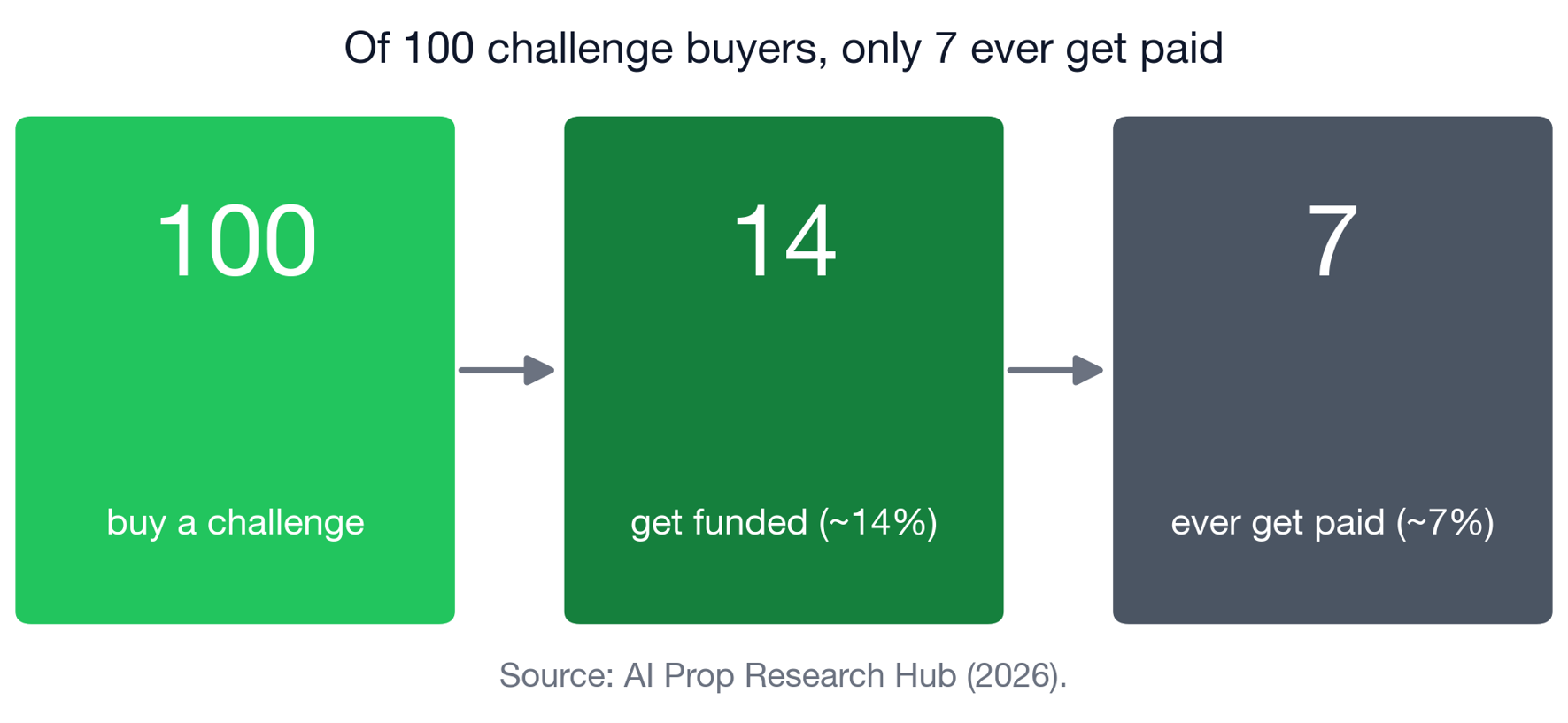
Of 100 traders who buy a challenge, about 14 get funded and only 7 ever get paid.
Now price the bet. Most people need more than one run, so the realistic outlay is around $1,600 across roughly three attempts at a $100,000 challenge, and across all account sizes the average spend per cycle sits near $800. When a trader does get paid, the average payout is about 4.0% of the funded account size. Small slice out, large pile of fees retained from everyone who missed. That is the trade you are actually taking, and the sales page rarely draws it as a funnel.
Where does the money actually go?
Most of a prop firm’s revenue comes from challenge fees, not from a cut of your profits, and that is what bends the incentive. Industry analysts estimate fees make up somewhere around 85.0 to 95.0% of a typical firm’s revenue. Treat that as an estimate, not an audited disclosure, because no central database of prop firm revenue exists, and even the broad annual numbers, often put at $2 to $4 billion globally, ship with an explicit “no audited data” caveat.
You do not need the exact figure to read the structure. When most of the money lands the instant someone buys in, a firm’s income stops depending on whether you eventually win. If you have ever wondered how prop firms actually make money , that is the whole answer in one line: the buyer who fails is not a missed sale, the buyer who fails is the business model.
The part crypto-native traders should care about most
The funnel decides whether you get paid. The ledger decides whether they can take it back. This is the half of the question most challenge buyers never ask, and it is the half a crypto-native trader is best equipped to evaluate.
Here is why it matters. A balance sitting in a firm-controlled dashboard is just a number the firm can edit. It can be delayed, adjusted, or quietly reversed, and you have no independent record to point to. In one documented case, a firm rolled out a minimum hold time overnight, applied it backwards to trades that were already closed, and clawed a settled balance from $3,200 down to $751.62, erasing $2,448.38 the trader had already earned. No bad trade caused it. A rule that did not exist when the trades were placed reached into the past and deleted the profit.
That is the structural risk an on-chain payout removes. A cleared payout written to a public ledger has a transaction record anyone can verify, and it cannot be silently reversed the way a dashboard figure can. One honest caveat, because it cuts both ways: an industry-wide on-chain total is not automatically a clean trader-payout signal, since the same wallets can pay affiliates and vendors, not only traders. A big on-chain number proves money moved, not who received it. What makes a figure meaningful is whether it is tied to a verified trader cohort rather than the whole wallet.
The honest part: the fee is not the villain
It would be easy to end here by telling you fees are a scam. They are not, and pretending otherwise would make everything above sound like a pitch. Charging a fee to filter for skill before handing over capital is a legitimate business model. AI Prop charges fees too. The fee is not where the damage lives.
The damage lives in what happens after you pass. Plenty of traders fail a challenge fair and square, hit a loss limit, blow an account, and own it. That stings, but it is not betrayal. The betrayal is the trader who did everything the page asked, passed clean, and then watched a clause decide they had not. Same fee at the front door, opposite intent at the back. A firm aligned with you makes money when you make money. A misaligned one makes money when you fail, and reaches for hidden, retroactive rules to keep failing you even after you have earned it. One prop firm founder said the quiet part on the record, describing how trouble starts “when rules are hidden, vague, changed retroactively, or used manually to avoid paying traders.” That is an operator describing his own industry.
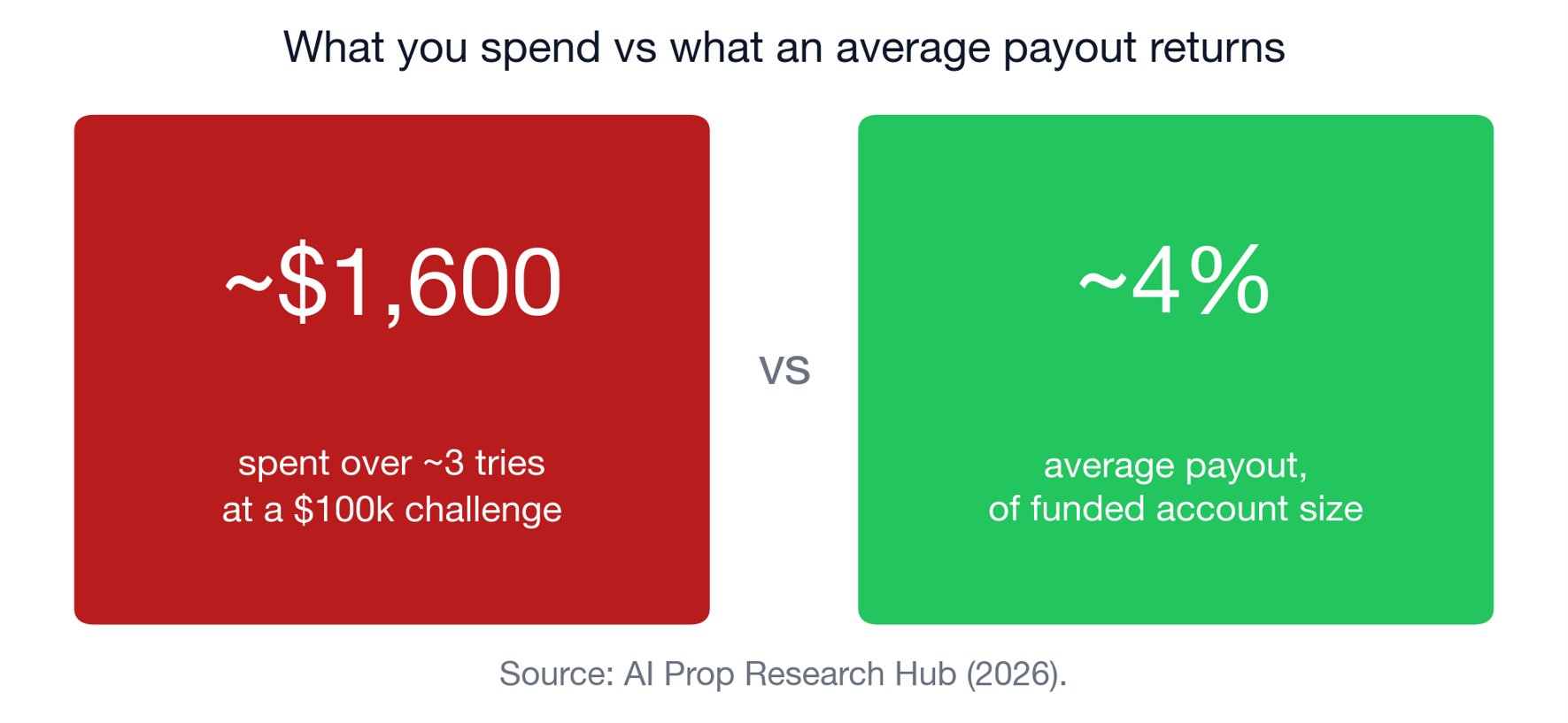
What an average run costs versus what an average payout returns.
A 30-second gut-check before you pay
You can usually read which side of that line a firm sits on before you hand over a cent. Three checks, in order.
First, read the withdrawal terms before you buy, not after you pass. The clause that decides whether a passed account gets paid lives in the fine print, and five minutes there beats a frozen payout later. Second, ask one blunt question: is a cleared payout reversible? If the money sits on a ledger the firm fully controls, the answer is yes. If it is on-chain, the answer is no. Third, check whether the rules are fixed and disclosed, or vague and changeable. A firm that can rewrite the rulebook mid-account, and apply the change backwards, has already told you what it does under pressure.
That last one is why some firms remove the levers entirely. AI Prop runs on a pass-first model, so the fee comes after you pass, not before. It publishes payouts on-chain, so a cleared payout is publicly verifiable and cannot be silently reversed. And it carries a Friction Score of 0/6, meaning the six most common friction rules, the consistency rule and minimum hold time among them, have been removed. AI Prop exclusive research records $1.7 million in verified cohort payouts across n=978 traders in Q1 2026, a traceable dataset tied to a specific cohort rather than a platform-wide marketing total. The fee still exists. You just are not paying it into a failure, and you are not trusting a number the firm can quietly edit.
Frequently asked questions
What percentage of prop traders actually get paid?
About 7.0%, based on the largest public dataset available. Across more than 300,000 accounts spanning ten firms, roughly 14.0% of traders passed the challenge and got funded, and fewer than half of those funded traders, around 45.0%, ever reached a payout. That nets out to about 7 in every 100 who began. An independent tracker reports the same 7.0% figure for traders reaching a first payout. Treat it as your base rate: getting funded is the middle of the funnel, not the finish line.
Why does on-chain matter for a prop firm payout?
Because it changes who controls the record. A balance in a firm’s dashboard is a number the firm can adjust, delay, or reverse, and you have no independent proof. A payout written to a public ledger has a transaction record anyone can verify, and it cannot be silently undone. In one documented case a firm clawed a settled balance from $3,200 to $751.62 using a rule applied backwards, the exact move an on-chain, irreversible payout makes impossible. On-chain is not marketing here, it is a property of the receipt.
Is buying a prop firm challenge worth it?
It can be, but only with the funnel and the fine print in view. The average trader spends around $800 per cycle and closer to $1,600 across roughly three attempts at a $100,000 challenge, and only about 7.0% ever reach a payout. That does not make it a bad bet, but it makes the firm you choose the biggest variable in the equation. A challenge is worth far more when the firm pays reliably, discloses fixed rules, and cannot reverse a cleared payout, which is why reading the withdrawal terms first is the highest-value five minutes in the whole process.
If you trade fast, you already make decisions on probability and verifiable evidence. Apply both here: pick a firm whose incentive runs with your success and whose payouts you can verify yourself. See how AI Prop lines its pass-first model, on-chain payouts, and zero fricti