The financial brokerage landscape is undergoing a tectonic shift. For years, Introducing Brokers (IBs) and professional traders were forced to choose between two subpar worlds: the rigid, slow-moving structures of traditional Forex brokers or the high-risk, unregulated wild west of early crypto exchanges. Today, a new evolution has emerged—the hybrid broker. This model doesn’t just “add crypto” to a MT4 terminal; it fundamentally re-engineers how capital moves, how commissions are settled, and how master traders monetize their alpha.
As an analyst who has stress-tested dozens of partner programs, I’ve seen the same pattern: IBs hit a “growth ceiling” because their broker caps referral tiers or delays payouts by 30 days. The hybrid model, pioneered by platforms like Coinstrat Pro, dissolves these barriers. By combining institutional-grade execution (cTrader) with decentralized finance (DeFi) flexibility, the hybrid approach offers a level of scalability that traditional models simply cannot match. If you are a professional partner looking to scale Assets Under Management (AUM), the shift to hybrid isn’t just an option—it’s a competitive necessity.
Comparing Hybrid Brokerage Benefits for Prop Traders vs. Traditional Models
The primary hybrid brokerage benefits for prop traders and IBs include access to 1,200+ multi-asset instruments, 24/7 crypto liquidity, and institutional-grade social trading. Unlike traditional brokers, hybrid models like Coinstrat Pro offer millisecond execution and multi-level commission structures that allow for unlimited depth and customizable markups. This ensures that whether a client is trading EUR/USD at 10:00 AM or Bitcoin at 3:00 AM on a Sunday, the partner earns a consistent, reliable stream of revenue.

Defining the Hybrid Broker Evolution
A traditional broker is often a silo. You trade Forex and maybe a few indices. If you want to trade spot crypto, you open a second account elsewhere. If you want to copy a master trader, you use a third-party plugin that lags. A hybrid broker, conversely, integrates these into a single “Wealth Hub.” It bridges the gap between the speed of the crypto world and the regulatory robustness of traditional finance. For a prop trader or an IB, this means a significantly higher “Client Lifetime Value” (CLV). When your clients can trade everything from ETFs to meme coins under one roof, they don’t leave for other platforms.
Why Prop Trading Affiliates are Migrating to Hybrid Platforms
Prop trading has become the dominant force in retail finance over the last two years. However, many affiliates are realizing that what a prop firm is in Forex—specifically its benefits and risks—depends heavily on the underlying brokerage infrastructure. Traditional brokers often struggle with the high-frequency and high-volume demands of prop-style trading. Hybrid platforms use advanced data centers and Tier-1 liquidity providers to guarantee execution speeds under 100 milliseconds. This technical superiority reduces slippage, which is the #1 killer of prop trader performance. When your traders win more often, your IB commissions grow more stably.
| Feature | Traditional Brokerage Model | Hybrid Brokerage (Coinstrat Pro) |
|---|---|---|
| Asset Variety | Mostly FX, limited Metals/Indices | 1,200+ Assets (FX, Crypto, Stocks, ETFs, Metals) |
| Execution Speed | 200ms – 500ms (Average) | Sub-100ms (Institutional Grade) |
| Trading Hours | Market Close on Weekends | 24/7 Trading availability for Crypto/Hybrid assets |
| IB Deep Growth | Capped at 2-3 tiers | Unlimited Depth (Multi-tier) |
| Wallet Integration | Fiat only / Static bank wires | Spot Crypto Wallet with instant internal transfers |
Commission Payout Speed: Why Instant Beats Monthly for Leading Partners
Speed of capital is a critical competitive advantage for any growing business. While traditional brokers often enforce 30-day settlement periods, the best instant payout forex partners provide real-time commission credit. This allows IBs to reinvest in marketing immediately, effectively compounding their business growth faster than competitors. In a high-inflation, fast-moving market, waiting four weeks to access your earned commissions is an opportunity cost that professional partners can no longer afford.

The End of the 30-Day Waiting Period
In the “old world” of brokerage, the monthly payout was standard because brokers needed time to reconcile trades and check for fraud manually. Hybrid brokers use automated reconciliation engines. The moment a trade is closed by a client, the commission is calculated and credited to the IB’s wallet. This transparency builds a massive amount of trust. If you are running paid traffic (Google Ads or Social Media) to acquire clients, having your commissions hit your account instantly means you can scale your daily ad spend based on real-time ROI, rather than waiting for a “payout day” to see if your campaign was profitable.
Calculating the ROI of Instant Reinvestment
Consider an IB earning $5,000 in monthly commissions. Under a traditional model, that $5,000 is “dead capital” for 30 days. In a hybrid model with instant payouts, that IB can take the $166 earned on Day 1 and immediately put it back into lead generation or a prop firm setup without huge capital. By Day 30, the hybrid IB has had 30 cycles of reinvestment, whereas the traditional IB is only just receiving their first check. The delta in growth over a 12-month period is exponential, not linear.
Monetization Showdown: 6-Way Fee Structures vs. Standard Profit Sharing
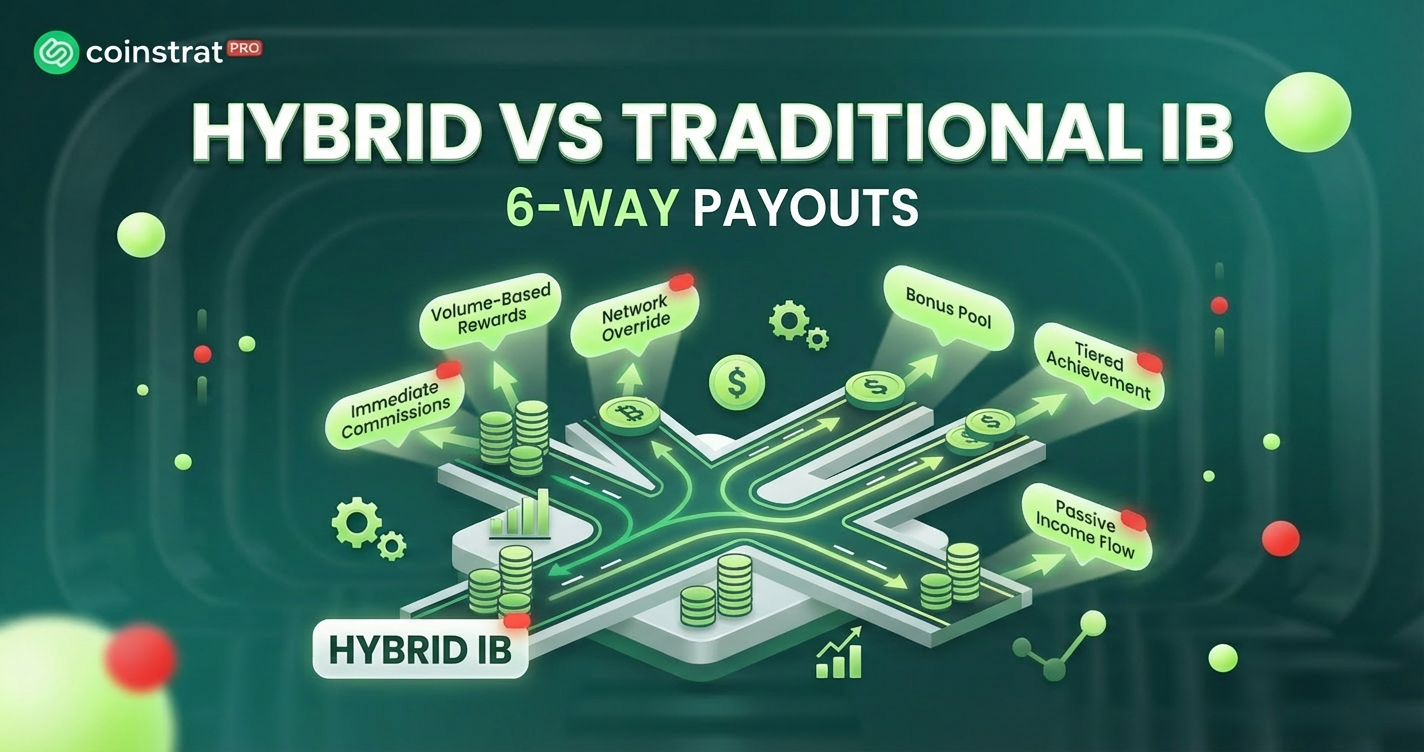
Most social trading platforms offer a simple profit-share model, which only rewards the master trader when the client wins. Coinstrat Pro disrupts this with a multi-tier fee structure for master traders, including volume, performance, management, subscription, joining, and profit fees. This diversity provides IBs with multiple revenue streams from a single client’s activity, ensuring income even during periods of market consolidation where “pure profit” might be harder to capture.

Diversifying Your IB Revenue Streams
Relying solely on a percentage of a trader’s profit is risky. If the market goes sideways and your master trader doesn’t close winning trades for two weeks, your income drops to zero. A hybrid broker allows you to customize how you get paid. By utilizing a multi-tier fee structure for master traders, you can earn from:
- Volume Fees: Get paid on every lot traded, regardless of the outcome.
- Management Fees: A small percentage of the total AUM, providing a steady “base salary” feel to your earnings.
- Subscription Fees: Charge a flat monthly fee for access to exclusive strategies.
- Performance Fees: The traditional high-water mark profit share.
Custom Markup: The Secret to High-Volume Rebates
One of the most overlooked features of the Coinstrat Pro ecosystem is the ability for IBs to set their own markups on raw prices. For institutional partners or those managing large groups, this allows you to tailor your pricing to your specific niche. If you are providing high-value educational content or signals, you can justify a slightly higher spread in exchange for the value you provide. This level of “Business-in-a-Box” customization is why high-level partners are leaving legacy brokers who offer “take it or leave it” fixed commission rates.
Building Longevity with Multi-Level Sub-IB Networking
Recruiting sub-IBs for long-term growth requires a platform that supports unlimited tiers. Traditional brokers cap rewards at 2 or 3 levels, but an unlimited multi-level structure ensures that as your network expands globally, your overwrite commissions continue to scale without an artificial ceiling. This creates a legitimate “Network Effect” where every new partner brought in by your sub-IBs adds to your bottom line, perpetually.

Strategies for Recruiting High-Performance Sub-IBs
The key to building a massive network is providing your sub-IBs with tools they can’t get elsewhere. When you show a potential partner the top tier prop firm features available on a hybrid platform—such as 6 allocation methods for copytrading and 1:500 leverage—the recruitment process becomes easy. You aren’t just selling a broker; you’re selling a technological edge. High-performance sub-IBs want to know that their clients won’t be “hunted” by the broker and that their commissions are secure and transparent.
Managing Global Networks with Advanced Analytics Tools
Scaling to 5 or 10 tiers of sub-IBs would be an administrative nightmare without the right tech. Hybrid brokers leverage AI-driven dashboards to track every pip and every cent across your entire genealogy. You can see which regions are growing fastest and where you need to provide more marketing support. This data-driven approach is what separates the modern “Wealth Manager” from the old-school “Referral Agent.” As we move into 2025 – the era of prop trading and social finance, the ability to manage a global, multi-asset network from a single dashboard is the ultimate “unfair advantage.”
“The transition from traditional IBs to Hybrid Partners is mirroring the transition from local banks to FinTech apps. Those who move early capture the liquidity; those who stay behind pay the fees.”
For those looking to find the right fit for their style, whether it be futures or spot, checking a prop firm match guide can help align your strategy with the right hybrid infrastructure. The goal is no longer just “to trade”—it is to build a scalable financial ecosystem that generates revenue 24/7, across every asset class imaginable.
Actionable Steps for Professional Partners
- Audit Your Current Latency: Check your broker’s execution speed. Over 200ms? You’re losing client money (and your own rebates).
- Review Payout Terms: If you aren’t getting instant payouts, calculate how much marketing growth you’re losing to the 30-day wait.
- Diversify Assets: Ensure your partner link allows for Crypto, Stocks, and FX. If BTC hits a new all-time high and your clients can’t trade it with you, they will find someone else who lets them.
- Leverage the Multi-Tier Model: Start recruiting sub-IBs who specialize in different niches (e.g., a Crypto influencer and a Gold signal provider) to balance your revenue streams.
FAQ
What is the difference between a traditional forex IB and a hybrid broker IB?
A traditional Forex IB typically earns only from spreads/commissions on FX and a few metals, with payouts usually settled monthly. A hybrid broker IB, like those at Coinstrat Pro, earns across a vast array of assets including 1,200+ instruments (Crypto, Stocks, ETFs), benefits from instant payouts, and has access to more complex monetization tools like 6-way fee structures for social trading.
Can I migrate my existing trader network from a traditional broker to Coinstrat Pro?
Yes. Platform transitions are common for high-level IBs seeking better infrastructure. Coinstrat Pro provides a comprehensive IB toolkit, including promo codes and customizable markups, to make the migration seamless for your existing clients while offering them superior execution through the cTrader terminal.
How does the ‘Unlimited Level’ depth benefit long-term network builders compared to 3-tier systems?
In a 3-tier system, your earning potential stops the moment your network grows beyond the third referral. In an ‘Unlimited Level’ system, you continue to earn a percentage of the volume from the 10th, 20th, or 100th level deep. This allows for exponential growth and encourages you to help your sub-IBs grow their own massive networks, as their success directly compounds yours.
Is the instant payout feature available for all 1,200+ tradable instruments?
Yes. The automated commission engine at Coinstrat Pro is designed to calculate and credit rebates instantly across all supported asset classes, whether your clients are trading major FX pairs, spot cryptocurrencies, or global stocks.