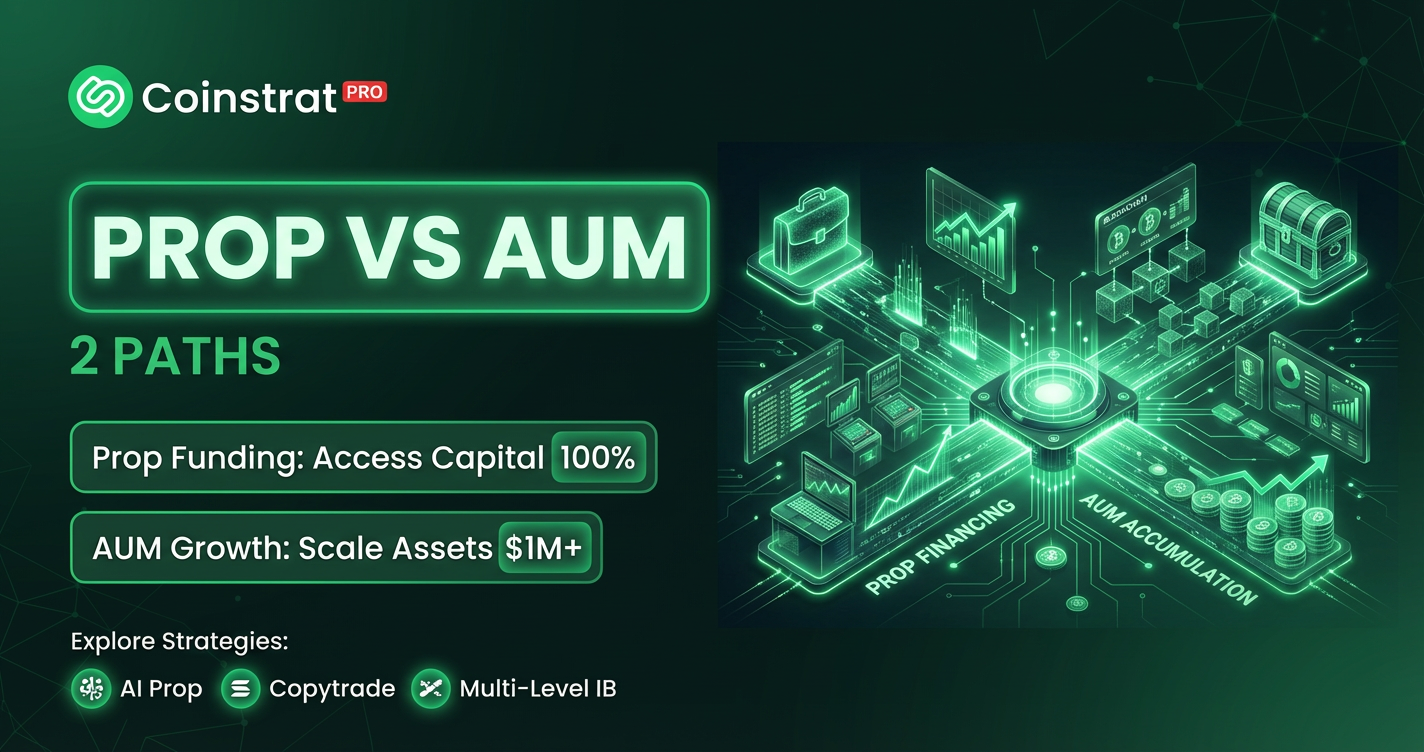
The transition from a retail “home trader” to a professional market participant usually happens at a specific crossroads: the moment you realize your strategy works, but your bankroll doesn’t. In 2026, the financial landscape has split into two dominant high-growth paths for those who possess the alpha but lack the capital. On one side, you have the rapid-fire world of AI Prop funding; on the other, the sustainable, long-term build of high-scale Assets Under Management (AUM) through social trading ecosystems.
Choosing between these two isn’t just about how much money you can trade; it’s about who controls the “keys to the kingdom” and how your labor is taxed, regulated, and scaled. While prop firms offer a shortcut to six-figure buying power, AUM management builds a personal brand that no firm can take away from you. Understanding the technical and structural nuances of these paths is the difference between a fleeting win and a lifelong career in the markets.
AI Prop Funding vs High-Scale AUM Management Analysis
The choice between AI Prop funding and AUM management depends on capital access and regulatory preference. AI Prop funding offers immediate access to large balances via specialized platforms like aiprop.com without client-facing hurdles, while AUM management allows for long-term residual income and scalable performance fees on a hybrid broker like Coinstrat Pro. Fundamentally, prop trading is an “on-demand” capital model, whereas AUM management is a “relationship-based” capital model.

In the prop model, you are essentially a contractor for a firm. You pass an evaluation—frequently involving AI-driven risk parameters that monitor your drawdown in real-time—and in exchange, you keep a high percentage of the profits (often 70-90%). The capital is not yours, and the rules are rigid. If you hit a 5% daily drawdown, your account is terminated instantly. This is why professional traders are switching to high-trust AI prop firms that offer more transparent rules, but the core limitation remains: you are trading someone else’s book under their specific, often suffocating, thumb.
Conversely, high-scale AUM management involves attracting followers or investors to mirror your trades. Here, you are the “Master.” Instead of a single firm providing capital, you have a 1,000-person “crowd-sourced” fund. The regulatory burden is different; while you aren’t managing a hedge fund in the traditional sense, you are providing a signal that others choose to follow. The advantage here is longevity. If a prop firm goes out of business, your income vanishes. If you have 500 loyal followers on a platform with Prime Liquidity and cTrader integration, you can move that community anywhere. You own the relationship, not the firm.
| Feature | AI Prop Funding | High-Scale AUM Management |
|---|---|---|
| Capital Access | Instant (after passing evaluation) | Gradual (built through reputation) |
| Risk Ceiling | Hard limits set by the firm | Flexible; determined by lead trader |
| Profit Share | 70% – 90% of your own gains | 10% – 30% of Total AUM gains (Performance Fees) |
| Sustainability | Low (one mistake ends the account) | High (built on personal brand/track record) |
| Monetization | Trading profits only | Performance, Management, & Subscription fees |
Risk Profiles: Your Capital vs. Firm Capital
The psychological weight of these two models cannot be overstated. In AI Prop funding, the “fear” is binary: losing the account. In AUM management, the pressure is social: losing the trust of your followers. Data from 2025-2026 market cycles suggests that AUM managers tend to have smoother equity curves because the accountability to a community mirrors the “skin in the game” felt by institutional fund managers. Prop traders, conversely, often fall into “gambler’s ruin” during the final stages of an evaluation, leading to high turnover rates.
Decoding Bitcoin Copytrade Performance Fee Structures
Bitcoin copytrade performance fee structures typically range from 10% to 30% of net profits, often utilizing a ‘High-Water Mark’ (HWM) to ensure master traders only earn fees on new gains. Advanced hybrid brokers offer up to 6 distinct fee types, including subscription and volume-based models. This multi-layered approach allows a trader to monetize not just their “wins,” but the sheer activity and loyalty of their user base.
The High-Water Mark principle is the gold standard for fairness in professional trading. It ensures that if a trader loses 10% of the AUM in January, they cannot charge a performance fee on the 10% gain in February—they must first exceed the previous peak (the “High-Water Mark”) before fees kick in again. This protects investors and forces Master Traders to focus on consistent, sustainable growth rather than volatile “spikes.” If you’re looking to legally charge and earn performance fees, utilizing a platform that automates HWM calculations is non-negotiable.
Management Fees vs. Performance Incentives
While performance fees reward “Alpha” (beating the market), management fees reward “Beta” (the service of being there). Top-tier Bitcoin lead traders in 2026 often combine these. For example, a Master Trader might charge a 20% performance fee for the gains they generate, plus a small monthly subscription fee for access to their private Discord or educational content. This dual-stream approach stabilizes the trader’s income during sideways markets where Bitcoin might chop for months without providing a clear “exit” for profit-taking.
“The shift from simple profit-sharing to sophisticated fee ecosystems is what separates the hobbyist from the professional wealth manager. In a hybrid brokerage environment, you aren’t just a trader; you’re a fintech entrepreneur.”
Monetizing AI Trading Signals in Prop Firms and Social Ecosystems
Traders can monetize AI trading signals in prop firms by achieving funded status or by broadcasting those signals to a social trading community. By integrating signals with a sophisticated copytrade engine, masters can generate dual income from both their own trades and a percentage of followers’ profits. This is the ultimate “force multiplier” in modern finance: using code to generate the trade, and using a social network to multiply the capital behind that trade.

The most successful strategy in 2026 involves a hybrid approach. A trader uses an AI-driven signal bot to pass a prop evaluation at aiprop.com. Once funded, they connect that same signal provider to a master account on a platform like Coinstrat Pro. Now, every trade executed on the prop account is mirrored by hundreds of retail followers. This creates a “triple-threat” revenue stream:
- The 80% profit split from the Prop Firm.
- Performance fees from the social followers.
- Volume-based commissions if the trader is also acting as an IB (Introducing Broker).
To scale this, understanding how to start and scale a professional trading signal business is essential. You need a platform that supports API integration, allowing your Python or PineScript-based AI to fire orders directly into the cTrader terminal with zero manual intervention.
Building a Reputation on Global Leaderboards
In the AUM model, your “Curriculum Vitae” is the leaderboard. In 2026, investors are no longer looking for the highest percentage gain; they are looking for the best Sharpe Ratio and the lowest maximum drawdown. A Master Trader who earns 50% a year with a 5% drawdown is 10x more valuable than one who earns 500% with a 60% drawdown. The leaderboard transparency provided by hybrid brokers allows retail investors to filter for “Institutional Quality” traders, making it easier for disciplined masters to attract high-net-worth capital.
Operational Efficiency: Millisecond Execution and Global Connectivity
For both prop and AUM models, execution speed is paramount. Hybrid brokers bridge this gap by offering cTrader’s millisecond execution and SWIFT/SEPA connectivity, ensuring that profits are not lost to latency and that international commissions can be withdrawn instantly. In Bitcoin trading, where a “flash crash” can occur in seconds, being on a legacy platform with 500ms+ latency is essentially a tax on your performance.
This is particularly critical for Copytrade for Investors. If a Master Trader enters a Bitcoin long at $68,000, but the follower’s account doesn’t execute until $68,050 due to server lag, the follower’s profit margin is eroded. Over 100 trades, this “slippage” can be the difference between a profitable year and a losing one. Hybrid brokers solve this by using Prime Liquidity data centers located in the same hubs as major exchanges, reducing the physical distance data must travel.
Instant Payouts for High-Scale Affiliates and Masters
One of the biggest friction points in traditional finance is the “waiting period.” Traditional brokers often hold commissions for 30 days. In the fast-moving crypto and multi-asset world of 2026, professional IBs and traders demand instant liquidity. If an IB’s network executes a massive volume of trades during a Bitcoin breakout, they should see those commissions in their Spot Crypto Wallet within minutes, not weeks. This allows for rapid reinvestment or “compounding” of the business operations.
The scalability of the IB model is further enhanced by “Unlimited Level” structures. In a standard model, you only earn from direct referrals. In a professional hybrid model, you build an organization. You can succeed in prop trading affiliate marketing by building a hierarchy of “Sub-IBs”—each focusing on different regions or asset classes—while you manage the overall strategy and liquidity flow.
Why Traditional Models are Fading
As we navigate 2026, the “walled garden” approach of old-school brokers is failing. Traders want a single dashboard where they can manage a Bitcoin prop account, a Forex AUM pool, and a crypto savings account simultaneously. The separation of “Crypto vs. TradFi” is over. The winners are those using high-performance infrastructure to bridge these two worlds, ensuring every millisecond of execution and every cent of commission is optimized for growth.
Actionable Steps for the Aspiring Professional
- Audit your strategy: Is it high-risk/high-reward? (Best for Prop). Is it consistent/low-drawdown? (Best for AUM).
- Choose your “Stack”: Ensure your broker uses cTrader for its superior API and millisecond execution.
- Layer your income: Never rely solely on trading gains. Set up a Master Trader profile to begin collecting performance fees from day one.
- Automate your “Business”: Use AI signals to remove emotion and allow for 24/7 market coverage across multiple asset classes (FX, Metals, Crypto).
FAQ
Which model offers better long-term scalability: Prop or AUM?
AUM management offers significantly better long-term scalability. While prop funding gives you a large “starting balance,” you are always capped by the firm’s maximum allocation and their risk rules. With AUM management, your “balance” is theoretically infinite—the more your reputation grows, the more capital you attract. Furthermore, you build a personal brand and a portable client base that is not tied to a single firm’s survival.
What are the typical performance fees for Bitcoin lead traders?
Typical performance fees range from 15% to 30%. In 2026, the industry standard has settled around 20% for established traders with a proven track record (Sharpe Ratio > 2.0) and 10-15% for those looking to build their initial following. These are almost always governed by a High-Water Mark to ensure fair billing.
Can I copytrade a funded prop account?
Technically, yes, many hybrid brokers allow you to link your prop account’s execution to a social master account via API or specialized bridge software. This allows you to monetize your prop trading twice: once through the firm’s profit split and once through the performance fees of your social followers. However, always check your prop firm’s Terms of Service regarding “signal broadcasting.”
Is aiprop.com compatible with Coinstrat Pro?
Yes, because both platforms utilize high-performance infrastructure like cTrader and standardized API protocols. Many traders use aiprop.com to secure their initial trading capital and then use Coinstrat Pro as their “Social Hub” to broadcast those signals to a global audience, benefiting from the hybrid broker’s deep liquidity and instant commission payouts.