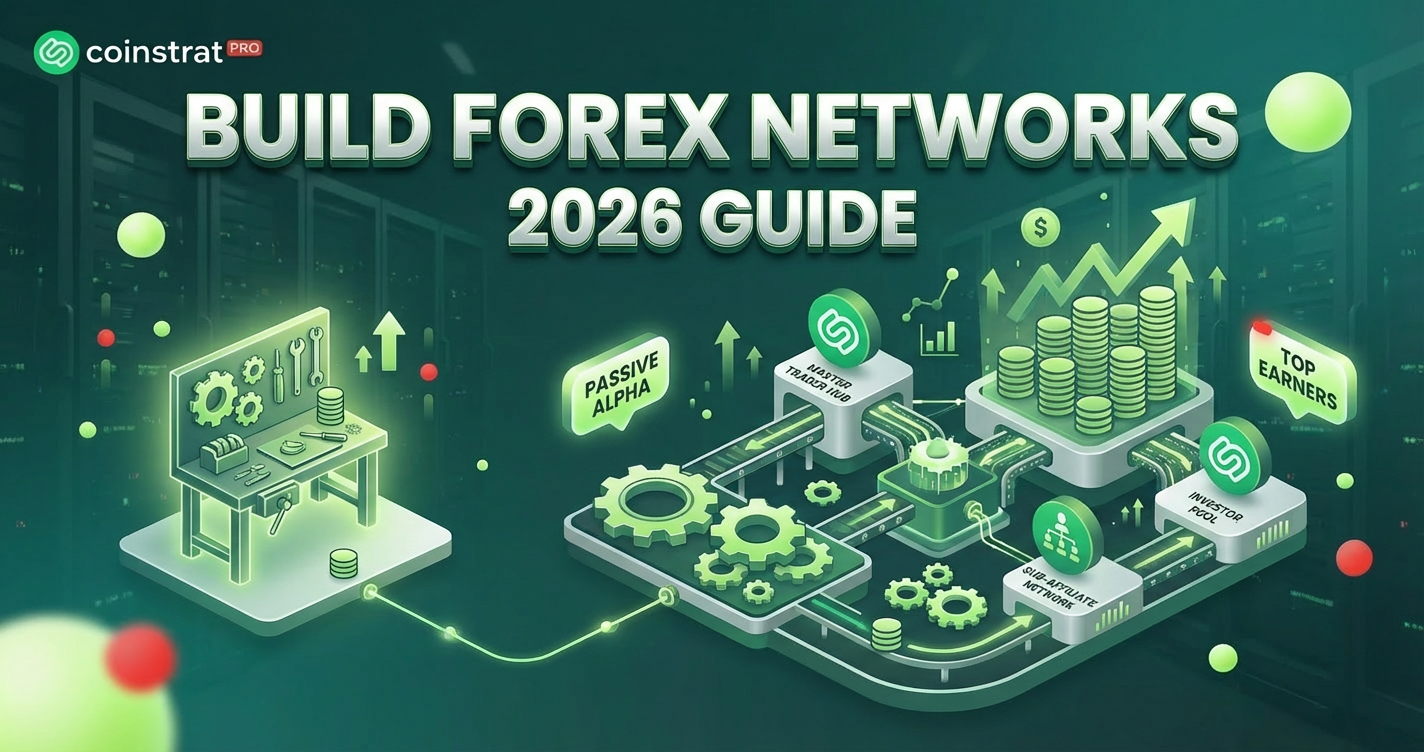
The transition from a solo Introducing Broker (IB) to the architect of a sprawling affiliate network is the financial equivalent of moving from a specialized craftsman to a factory owner. In the early days, you might focus on the quality of every single lead. But to hit the levels of passive alpha that define the industry’s top earners in 2026, you have to stop thinking about your own “sales” and start thinking about your “infrastructure.”
A high-performing forex affiliate network isn’t just a list of names; it is a living ecosystem of sub-affiliates, master traders, and retail investors. Building this requires more than just a link—it requires a deep understanding of multi-tiered commission structures, institutional-grade execution, and the psychology of high-volume partners. If you are still manually tracking spreadsheets or waiting 30 days for a payout, you aren’t building a network; you’re managing a bottleneck.
What are the foundational steps to build a forex affiliate network?
Building a forex affiliate network requires moving from personal referrals to a sub-affiliate model. Focus on recruiting ‘Master IBs’ who have their own audiences, and utilize a brokerage that supports multi-tier tracking. By offering customizable commission structures and high-performance tools like cTrader, you create a scalable ecosystem where you earn from every trade in your hierarchy. This shift from active acquisition to passive network management is the hallmark of professional growth.

1. Defining Your Tiered Commission and Markup Strategy
The first step in how to build a forex affiliate network is deciding how the “pie” is sliced. In a traditional 1-tier model, the broker pays you a fixed amount per lot. In a multi-level network, you need a broker that allows you to add a “markup” to the raw spread or share a portion of the commission with your sub-sub-affiliates.

The most successful network architects in 2026 use a hybrid of commission types. For example, some sub-affiliates might prefer a high CPA (Cost Per Acquisition) to cover their immediate ad spend, while others—the “Master IBs”—will demand a lifetime revenue share (RevShare) or a volume-based rebate. Your infrastructure must be flexible enough to accommodate both without you having to manually calculate the difference.
2. Identifying and Recruiting High-Value Sub-Affiliates
You don’t need a thousand low-quality leads; you need ten high-quality partners. Look for “Finfluencers,” educators, or signal providers who already have an established trust deficit with their audience. To attract them, you must offer something their current broker doesn’t. This often includes:
- Exclusive Tracking Links: Give them the ability to see their own conversion data in real-time.
- Marketing Support: Providing them with high-conversion landing pages and ad creatives.
- Better Liquidity: If their clients suffer from slippage, the sub-affiliate’s reputation suffers. Partnering with a broker that offers Multi-Level IB structures backed by Tier-1 liquidity ensures their network remains stable.
3. Providing the Technical Tools Your Network Needs
Your network is only as strong as the terminal it uses. In 2026, the industry has largely migrated toward high-performance environments like cTrader, which provides millisecond execution. If you are recruiting professional traders to act as “Anchors” for your network, they will demand tools that support algo-trading and deep liquidity. When your “Master Traders” perform well, your sub-affiliates have a much easier time selling the dream to retail investors.
Why daily payouts are the engine of affiliate growth
A daily payout forex affiliate program is critical for scaling because it improves cash flow for lead generation. Instead of waiting 30 days for commissions, IBs on platforms like Coinstrat Pro can instantly reinvest earnings into paid advertising or SEO, creating a compounding growth loop for their network expansion. In the hyper-competitive world of digital marketing, the person who can pay for their next ad today—rather than next month—always wins the auction.

The Impact of Instant Liquidity on Marketing Budgets
Consider the “Affiliate Death Spiral”: An IB spends $5,000 on Google Ads in January. They generate $8,000 in commissions. However, the broker doesn’t pay out until February 15th. For six weeks, the IB’s capital is locked. They cannot run new ads. Their growth stalls.
Contrast this with a daily payout model. That same $8,000 starts hitting the account daily. By January 10th, the IB has already recovered their initial $5,000 and can double their ad spend for the rest of the month. This velocity of capital is the secret reason why some networks grow 10x faster than others.
| Feature | Traditional Monthly Payout | Daily Payout Program |
|---|---|---|
| Cash Flow Velocity | Low (30-45 day lag) | Extreme (Instant access) |
| Reinvestment Potential | Requires external capital | Self-funding growth loops |
| Sub-Affiliate Retention | High churn due to payment anxiety | High loyalty due to transparency |
| Ad Spend Optimization | Fragmented and delayed | Real-time scaling |
Reducing Churn with Transparent Reporting
Sub-affiliates are notoriously skeptical. If they can’t see their commissions accumulating in real-time, they suspect “shaving” (brokers hiding leads). A daily payout system, combined with a transparent portal, builds a level of trust that prevents your top-performing partners from jumping ship to a competitor. When they see money hitting their wallet as soon as their client closes a trade, they become your brand ambassadors for life.
Overcoming common bottlenecks in multi-level IB structures
Most affiliate networks fail because of capped levels or hidden fees. To reach unlimited scale, you must partner with a hybrid broker that allows for ‘Unlimited Level’ depth. This ensures that even if a sub-affiliate ten levels deep brings in a whale, you still receive a fraction of that volume as the network architect. Without this depth, your “passive income” eventually hits a ceiling as your network outgrows your contract.

“The greatest mistake a Master IB can make is choosing a partner broker based on a high initial CPA rather than the long-term flexibility of the tiered structure. CPA is a one-time payment; a multi-level RevShare is an asset.”
Managing Large-Scale AUM Across Global Regions
As your network grows, you will inevitably deal with a mix of strategies. Some of your clients will be looking for “Retail Alpha,” while others will be high-net-worth individuals following a specific PAMM or MAM strategy. A high-performing network needs to provide these options natively. If a sub-affiliate wants to bring in a fund manager, your broker must have the infrastructure to support it. If they want to offer social copy-trading, the platform must facilitate it seamlessly.
Customizing Markups on Raw Prices
Different regions have different “market rates.” A sub-affiliate in Southeast Asia might focus on high-volume scalping where thin spreads are vital. A partner in Europe might focus on education and high-touch service, where they can justify a higher markup. The bottleneck in many traditional systems is a “one size fits all” spread. To scale effectively, you need the ability to customize markups for specific branches of your network, ensuring each sub-IB remains competitive in their local market.
The “Unlimited Depth” Advantage
Standard IB programs usually stop at 2 or 3 tiers. This creates a conflict of interest: if you recruit a brilliant marketer, and they recruit a brilliant marketer, you eventually lose the override on the third or fourth tier. This discourages you from helping your sub-affiliates grow. By choosing a partner like Coinstrat Pro that offers UNLIMITED referral tiers, you are incentivized to help every person in your hierarchy succeed, because there is no “cutoff” point for your earnings. This transforms your network from a list of names into a genuine community.
The Power of Multi-Asset Environments
In 2026, a Forex-only network is a vulnerable network. Markets rotate; when FX volatility is low, Crypto or Equities might be booming. A high-performing network must be built on a multi-asset environment. This allows your sub-affiliates to pivot their marketing according to global trends—promoting Gold during inflation or Crypto during bull runs—all while you continue to collect commissions from a single, unified dashboard.
Advanced Monetization: Beyond Simple Commissions
The elite 1% of IB network architects don’t just rely on lot rebates. They leverage the full suite of monetization tools provided by hybrid brokers. This includes:
- Subscription Fees: Charging a monthly fee for access to a private trading signal group.
- Performance Fees: Taking a percentage of the profits earned by clients following a Master Trader you’ve promoted.
- Dual Investment Income: Earning from the interest generated when clients hold digital assets in their spot wallets.
- Joining Fees: A one-time setup fee for exclusive “Pro” or “Institutional” tiers of your network.
By diversifying your income streams, your network becomes resilient to market crashes or low-volatility periods. You become more than just a middleman; you become a provider of diversified financial services.
A Strategic Roadmap for 2026
If you are serious about scale, your checklist for the coming year should look like this:
- Audit your Payouts: If you aren’t on a daily payout program, move. The lost opportunity cost of stagnant capital is too high.
- Test the execution: Use a platform like cTrader to ensure your traders aren’t being “slipped” out of profits.
- Expand the Asset List: Ensure your link allows clients to trade everything from BTC to ETFs.
- Enable Social Trading: Make it easy for your “lazy” leads to follow your “expert” leads. PAMM account management is the bridge between retail money and professional expertise.
The era of the “lone wolf” IB is over. The future belongs to the architects—the Master IBs who build interconnected networks where everyone, from the rookie investor to the professional whale, has the tools they need to succeed.
FAQ
What is the difference between a standard IB and a Master IB?
A standard IB (Introducing Broker) focuses primarily on referring direct clients to a brokerage and earns commissions on those clients’ trades. A Master IB acts as an “affiliate manager,” recruiting other IBs (sub-affiliates) to work under them. The Master IB earns commissions on their own direct direct clients AND an override commission on all the volume generated by their entire sub-affiliate network.
How do I track sub-affiliate performance across multiple levels?
Tracking is handled through a specialized Partner Portal or IB Dashboard. When you recruit a sub-affiliate, they are assigned a unique tracking ID that is linked to your Master ID. The portal provides real-time data on registration, deposits, and trading volume across every tier of your network, allowing you to see which branches are growing and which need more support.
What marketing materials are most effective for attracting high-net-worth traders?
High-net-worth (HNW) traders are rarely swayed by “get rich quick” banners. They value institutional-grade data, deep liquidity reports, and risk management proof. The most effective materials include detailed performance audits (Myfxbook or similar), white papers on execution speeds (low latency), and information regarding account security/insurance. High-quality webinars or exclusive market outlooks also perform well with this demographic.
Are there restrictions on the number of tiers I can build in my network?
Most traditional brokers cap their tiers at 2 or 3 levels to maintain their profit margins. However, high-performing hybrid brokers like Coinstrat Pro offer “Unlimited Level” IB structures. This means there is no technical limit to how deep your network can go; if a referral 100 levels down executes a trade, a fraction of that commission still filters up to the top-level network architect.