What defines a reputable AI Prop payout technology 2026?
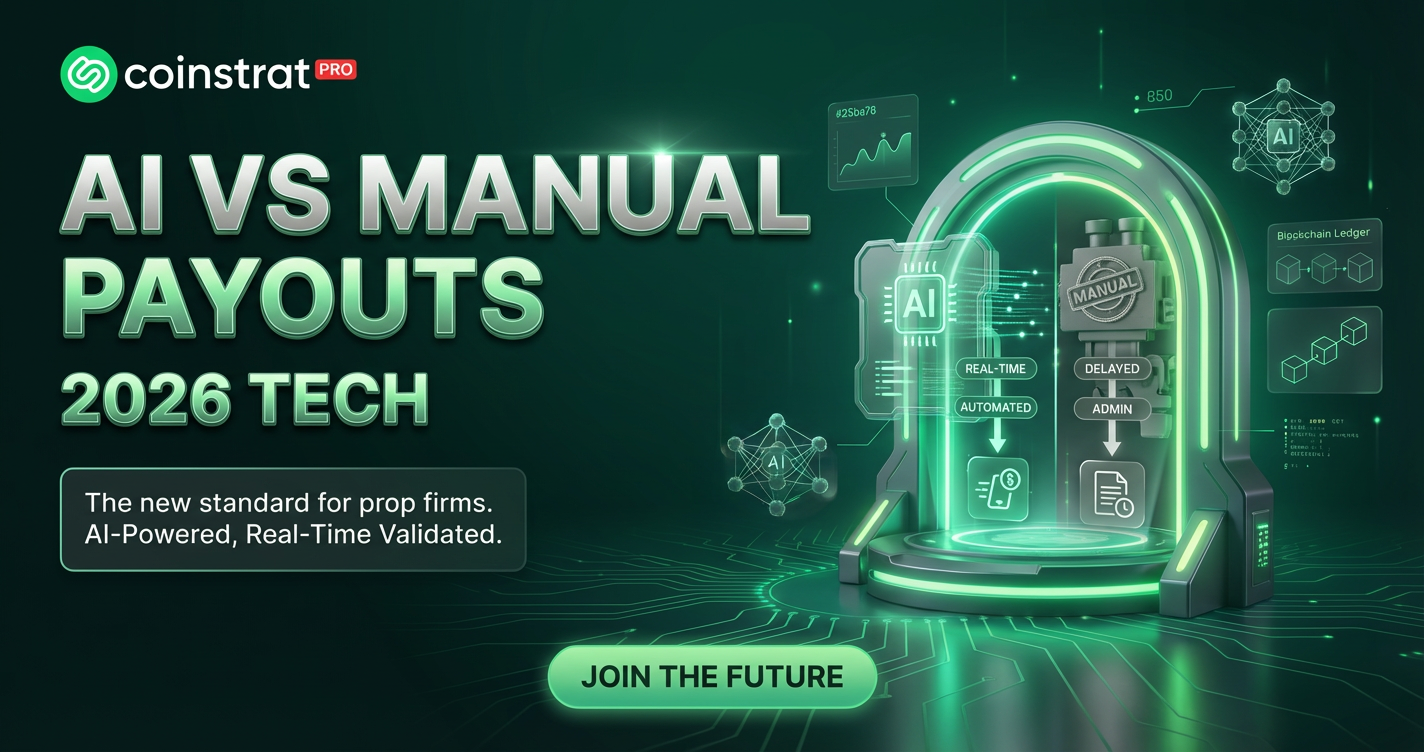
In 2026, reputable AI Prop payout technology is defined by real-time ledger integration, smart-contract-based profit distribution, and hybrid execution. Unlike older models, modern AI Prop technology ensures that payouts are mathematically guaranteed by verifiable trade data across multi-asset classes, reducing human intervention and increasing trust. By automating the verification of profit targets and drawdown limits, these systems eliminate the “payout friction” that historically plagued the retail prop industry, where manual audits could delay earnings for weeks.
The standard for credibility has shifted from “promises of payment” to “algorithmic certainty.” In the current landscape, AI Prop payout technology 2026 utilizes automated profit auditing to scan account history for compliance with risk parameters in milliseconds. This is a far cry from the 2023-2024 era, where many firms shuttered due to liquidity mismanagement or subjective rule enforcement. Today, top-tier platforms use blockchain-verified payout ledgers to provide a public, immutable record of processed rewards, ensuring that when a trader hits their target, the funds are allocated instantly to their wallet.
Furthermore, execution quality is now inextricably linked to payout accuracy. If a broker suffers from high slippage, the AI auditing the payout will recognize the discrepancy between the expected price and the filled price. Reputable firms integrate with institutional-grade terminals like cTrader to ensure that the data feeding the AI is accurate. This technological synergy protects the trader’s alpha, ensuring that the “paper profits” seen on the screen translate 1:1 into withdrawable capital without “administrative adjustments” that were common in manual legacy systems.
The role of automated profit auditing
Automated auditing is the backbone of modern prop firm trust. In a manual system, a human risk manager must verify if a trader violated a daily loss limit or a consistency rule before authorizing a withdrawal. This creates a bottleneck. AI-driven systems, however, perform continuous monitoring. The moment a withdrawal is requested, the AI validates the entire trade history against the firm’s risk engine. If the data matches, the payout is triggered. This level of automation is why why traders are switching to AI powered prop firms for more reliable financial outcomes.

Blockchain-verified payout ledgers in 2026
2026 has seen the widespread adoption of on-chain verification for prop firm payouts. By publishing anonymized payout hashes to a public or private ledger, firms prove they have the liquidity to pay their successful traders. This transparency effectively ends the “Ponzi-style” rumors that once haunted the industry, where new evaluation fees were suspected of funding older payouts. In an AI-driven model, the payout is a result of a verified trading performance, often backed by deep liquidity pools rather than just fee revenue.
Why professional traders are moving away from legacy firms
Professionals are transitioning to AI-integrated brokers because legacy firms often lack the transparency needed for high-frequency or algorithmic strategies. AI Prop frameworks provide granular data on execution quality and fee transparency, which are essential for traders managing significant capital or utilizing sophisticated automated systems. For those trading at a professional level, the “black box” nature of manual prop firms—where rules can be changed mid-challenge—is a non-starter.

The core issue with legacy models is the transparency gap. Many traditional prop firms operate on a “B-book” model, where they profit from trader losses. This creates an inherent conflict of interest. AI-powered firms, particularly those using a hybrid broker infrastructure, connect traders to institutional-grade multi-asset liquidity. This means the firm earns when the trader trades, aligning the interests of the platform and the investor. When you look at a Prop Firm Review exploring the strongest funding models for 2025 and beyond, the highest-rated firms are almost always those that have outsourced their risk management to objective AI protocols.
Scalability is another driving factor. Professional “Master Traders” often hit a ceiling with manual firms that cannot handle rapid increases in Assets Under Management (AUM). AI Prop systems are built to scale dynamically. Whether a trader is managing $100,000 or $10,000,000, the AI handles the risk offsets and payout calculations with the same level of precision. This makes they hybrid broker model—combining crypto-native benefits like spot wallets with institutional FX execution—the preferred choice for 2026’s elite performers.
| Feature | Legacy Manual Systems | AI Prop Payout Systems (2026) |
|---|---|---|
| Payout Speed | 3–10 Business Days | Instant to 24 Hours |
| Risk Enforcement | Subjective / Manual Review | Algorithmic / Real-time |
| Data Integrity | Internal Spreadsheets | Blockchain-Verified Ledgers |
| Conflict of Interest | High (Profit from losses) | Low (Aligned via Liquidity) |
| Asset Range | Mostly FX / Indices | Full Multi-Asset (Crypto, Metals, ETFs) |
Mastering AI Prop master trader fee structures
Modern AI Prop fee structures go beyond simple profit splits. They include volume-based rewards, performance tiers, and management fees. For example, a professional trader might choose a ‘Raw Spread’ model with a 10% performance fee to maximize long-term AUM growth rather than a simple 80/20 split. These AI Prop master trader fee structures are designed to incentivize long-term consistency over short-term “gambling” for a single payout.
Under these advanced models, a Master Trader is essentially running their own mini-fund. The AI tracks not just the net profit, but the Sharpe ratio, Sortino ratio, and max relative drawdown. Traders who maintain high scores in these areas are often moved into higher “Fee Tiers.” This might include receiving a portion of the “Joining Fees” from followers or a “Management Fee” based on the total AUM they attract to the platform. This ecosystem creates a massive monetization opportunity that traditional prop firms simply cannot match. To see how these models are evolving, one should look into top tier prop firm features investors should look for.
For high-level Introducing Brokers (IBs), these AI structures are groundbreaking. Instead of a flat referral fee, AI Prop platforms allow for unlimited multi-level rewards. An IB can customize their own markups and commissions across an entire network of traders. Because the AI manages the distribution, payouts are instant. When a sub-referral closes a trade in London, the IB in Tokyo sees their commission hit their wallet in milliseconds. This is the hallmark of instant payout prop firms for professionals who demand liquid capital to grow their marketing reach.
Performance-based tiering for expert traders
In 2026, the elite “Master” status is earned through data, not just dollar amounts. AI systems categorize traders into tiers. Tier 1 traders might keep 80% of profits, while Tier 5 traders—who have proven they can manage millions with low volatility—might negotiate custom 95/5 splits and additional volume rebates. This tiering ensures that the most skilled individuals have the highest incentive to remain on the platform, fostering a community of “professional alpha.”
Customizing payouts for multi-asset strategies
A trader specializing in high-volatility Crypto assets has different risk needs than one trading Gold (XAU) or S&P 500 futures. AI Prop technology allows for asset-specific payout rules. For instance, a trader can set a higher risk-to-reward requirement for their crypto trades while maintaining a standard equity curve for their FX trades. This granularity ensures that the payout system respects the nuances of different market dynamics. Those interested in futures specifically should check the 5 best futures prop trading firms in 2025 to see how AI is applied in that sector.
“The difference between a trader who survives and a trader who thrives in 2026 is the bridge between their strategy and their dealer. Manual systems are the bridge made of wood; AI-driven hybrid brokers are the bridge made of steel.”
Volume rewards and subscription-based monetization
Beyond the profit split, the most successful participants in 2026 are diversifying their income. By utilizing the copytrade features of a hybrid broker, Master Traders can charge a monthly subscription fee to their followers. The AI handles the “permissioning”—ensuring only active subscribers get the signals—and automates the collection of fees. This allows a trader to generate a steady “salary” from their following, regardless of whether the market was flat or trending that month.
The Hybrid Advantage: Why Infrastructure Matters
The credibility of a payout system is only as good as the broker’s liquidity. This is where the concept of a “Hybrid Broker” like Coinstrat Pro becomes essential. By merging the high-speed execution of the cTrader terminal with a vast array of 1,200+ instruments—including everything from Spot Crypto to ETFs—the platform ensures that the data used by the AI to calculate payouts is “clean.”
In many retail-only prop firms, the “price” you see on the screen is an internal feed that can be manipulated (A-book vs. B-book). A hybrid broker utilizes Prime Liquidity from Tier-1 providers. When the AI sees a profit on a trader’s account, that profit is backed by real market movement. This infrastructure is what allows for instant internal transfers and multi-account budgeting, giving the trader total control over their realized gains. Whether you are a retail investor seeking alpha or an IB building a global network, the shift toward prop firms with AI-powered risk management is the single most important trend to follow this year.
Actionable Steps for Selecting an AI Prop Partner
- Verify the Execution: Look for platforms using cTrader or similar institutional terminals. High latency (over 100ms) is a red flag for payout accuracy.
- Audit the Fee Structure: Ensure there are at least 4–6 different ways to monetize. If the only option is a “Profit Split,” you are likely dealing with a legacy model.
- Test Internal Liquidity: A truly credible platform will allow you to move funds between a “Prop” account and a “Spot Wallet” or “Savings Account” instantly.
- Check Multi-Asset Support: Avoid firms that limit you to only Forex. 2026 is the year of the multi-asset trader; your funding should mirror that.
FAQ
Can I use custom underwater management scripts with AI Prop tools?
Yes. Modern AI Prop systems are designed to be “script-agnostic.” As long as your underwater management (hedging, trailing stops, or basket closures) does not violate the hard-coded drawdown limits of the firm’s AI risk engine, these scripts can actually improve your “consistency score,” leading to higher payout tiers.
How does slippage affect AI-driven payout calculations?
In an AI-driven system, payout calculations are based on realized equity, not “expected” profit. If slippage occurs, the AI calculates the payout based on the actual entry and exit timestamps provided by the liquidity bridge. Reputable firms use Prime Liquidity to keep slippage under 0.1 pips, ensuring your calculated payout remains accurate.
Are there consistency rules for AI-assisted traders in 2026?
Most AI Prop firms have moved away from rigid “30% rule” consistency models toward “Behavioral Scoring.” The AI looks for patterns of “revenge trading” or “gambling” (sudden lot size increases). If your AI-assisted trades maintain a steady risk-per-trade profile, you will remain eligible for maximum payouts without needing to follow old-school manual consistency checks.
Can I switch between cTrader and other terminals while maintaining AI Prop eligibility?
While some firms allow multi-terminal access, it is generally recommended to stay within a single ecosystem like cTrader for AI Prop challenges. This is because the AI risk engine requires a continuous, synchronized data feed to verify daily loss limits. Switching terminals can cause “sync lag,” which might trigger a false risk violation in the AI’s auditing process.